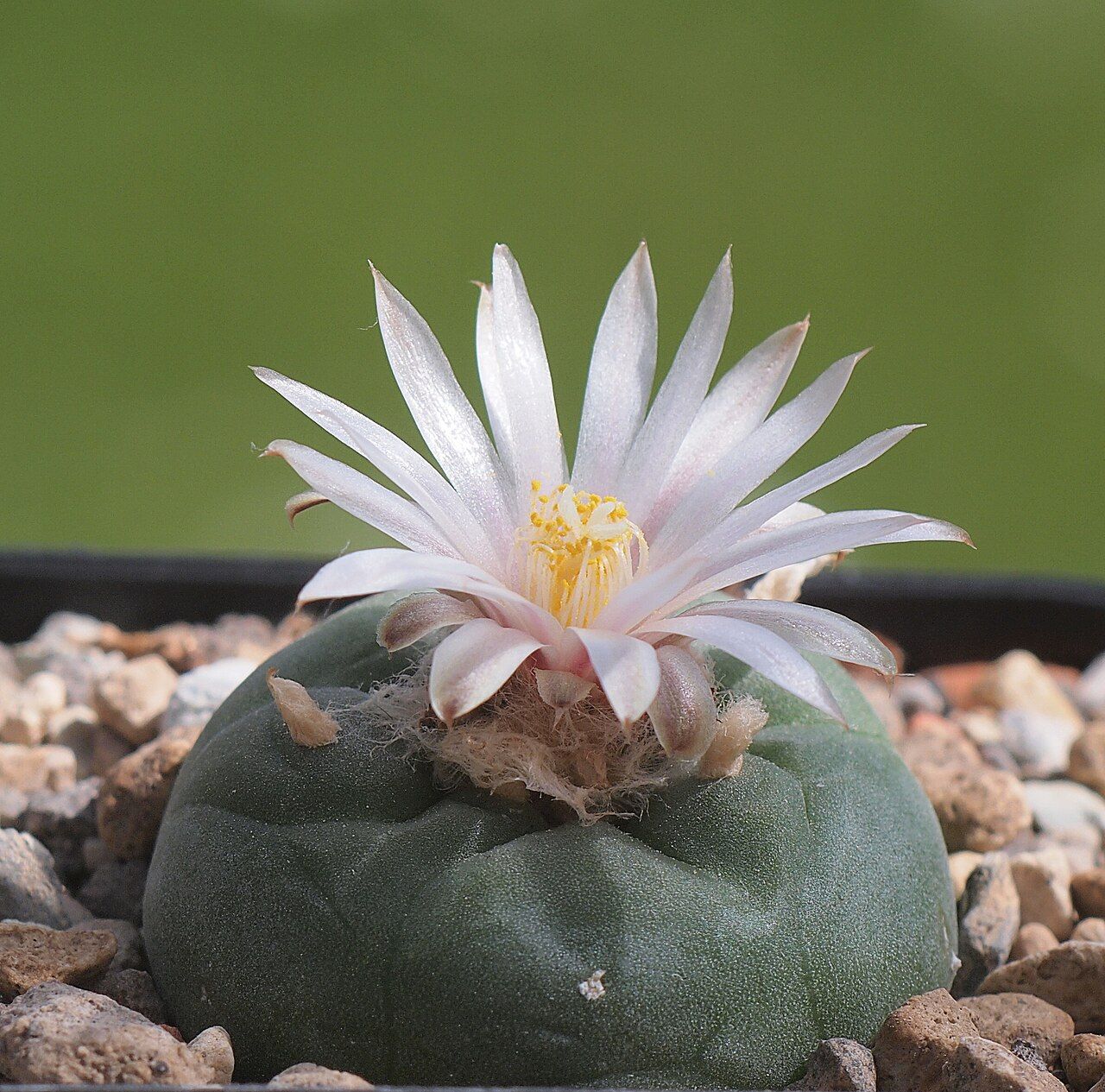
Quick facts
| Family | Cactaceae |
|---|---|
| Subfamily | Cactoideae |
| Tribe | Cacteae (subtribe Cactinae) |
| Genus | Lophophora |
| Name as published | Lophophora koehresii (Říha) Bohata, Myšák & Šnicer (2005); basionym L. diffusa var. koehresii Říha (1996) |
| Rank in use | Species (Bohata, Myšák & Šnicer 2005); also treated as L. diffusa var. koehresii or L. williamsii var. koehresii (Grym) |
| Kew (POWO) status | Synonym of Lophophora diffusa (Croizat) Bravo |
| Native range | Mexico: a drainless basin between Río Verde, San Luis Potosí, and Tula, Tamaulipas, about 1,050 m |
| Habitat | Shallow lake beds on soft alluvial sediment, under water for days to weeks in the rainy season |
| Named for | Gerhard Köhres, German nurseryman |
| Conservation status | No separate IUCN assessment; covered under L. diffusa (IUCN Vulnerable) |
Description
A small, spineless, globular cactus with a characteristically dark green body and ribs that stand out more strongly than in L. diffusa, which runs yellow-green to grey-green. Flowers are pinkish to cream with a darker pink or brownish midstripe, over 3 cm across, with unusually thin petals. The fruit ripens from creamy white to rosy pink and holds twenty or more seeds.
The seeds are the clearest character: the hilum (the scar where the seed was attached) is open and almost circular, and the seed coat is net-patterned rather than knobbly, a structure described as unlike any other Lophophora.
In habitat, plants pull themselves down into the mud during the dry season until they are almost completely buried, then reappear after the rains.
The more recently described L. alberto-vojtechii from San Luis Potosí is smaller still; its flower tepals are more rounded at the tip.
LLIFLE · Lophophora koehresii ↗ · Cactus Conservation Institute · koehresii ↗
Taxonomy and names
Říha described the plant in 1996 as Lophophora diffusa var. koehresii (Kaktusy 32(3): 70). Bohata, Myšák and Šnicer raised it to species rank in 2005 as Lophophora koehresii (Kaktusy special issue 2: 20), and Grym placed it as a variety of L. williamsii. Its separate range, darker body and distinct seed coat are the main reasons Lophophora specialists continue to treat it as its own taxon.
Kew's Plants of the World Online lists L. koehresii and L. diffusa var. koehresii as synonyms of L. diffusa. That is a difference in rank, not a claim that the population does not exist. Keep "koehresii" on the label together with any seed-lot or locality record.
Cultivation
Grow as for L. diffusa: a fast-draining mineral mix, bright light, and a dry, frost-free winter. See the soil-mix guide and the seasonal-care calendar.