Quick facts
| Scope | Horticultural crosses among Trichocereus-type Echinopsis (including former Trichocereus), bred mainly by hobbyists and small nurseries |
|---|---|
| Genus | Echinopsis — both historic parent genera (Trichocereus and Echinopsis) are treated as one genus under the primary Kew treatment |
| Related page | See Echinopsis Schick hybrids for a separate, Huntington-documented cross program with its own accession numbering |
| Legal/conservation status | As for the parent species involved: CITES Appendix II, as for the whole family Cactaceae |
Taxonomy and names
A true intergeneric hybrid between the old genera Trichocereus and Echinopsis was historically given the nothogenus (hybrid-genus) name ×Trichopsis. Because both parent genera are now treated as one genus, Echinopsis, under the primary Kew treatment, these crosses are now usually written as plain Echinopsis hybrids rather than a true intergeneric cross.
Standard cultivated-plant naming (the International Code of Nomenclature for Cultivated Plants, 9th ed., 2016) applies: a hybrid grex or cross name is not italicized; a selected clone's cultivar epithet goes in single quotes and is not italicized (for example Echinopsis 'First Light'); a multiplication sign "×" marks a true hybrid formula or nothotaxon, placed before the epithet or genus name — not the letter "x".
Record the seed parent first and the pollen parent second when the breeder's convention is known. An open-pollinated seed lot has an identified seed parent but unresolved pollen parentage; preserve the breeder's exact notation rather than guessing. A seedling sold under a parent cultivar's name is not automatically identical to that parent — give each seedling its own record with its cross or lot reference.
Cultivars and forms
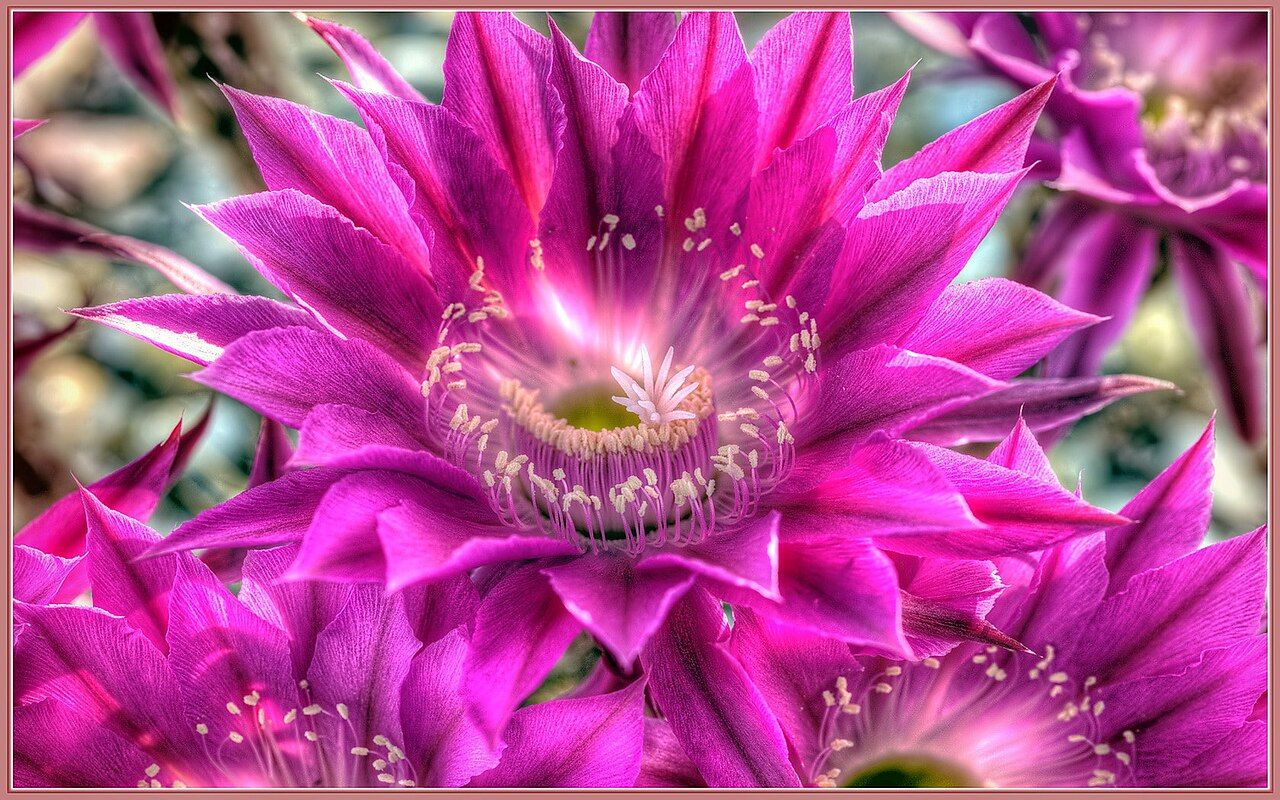
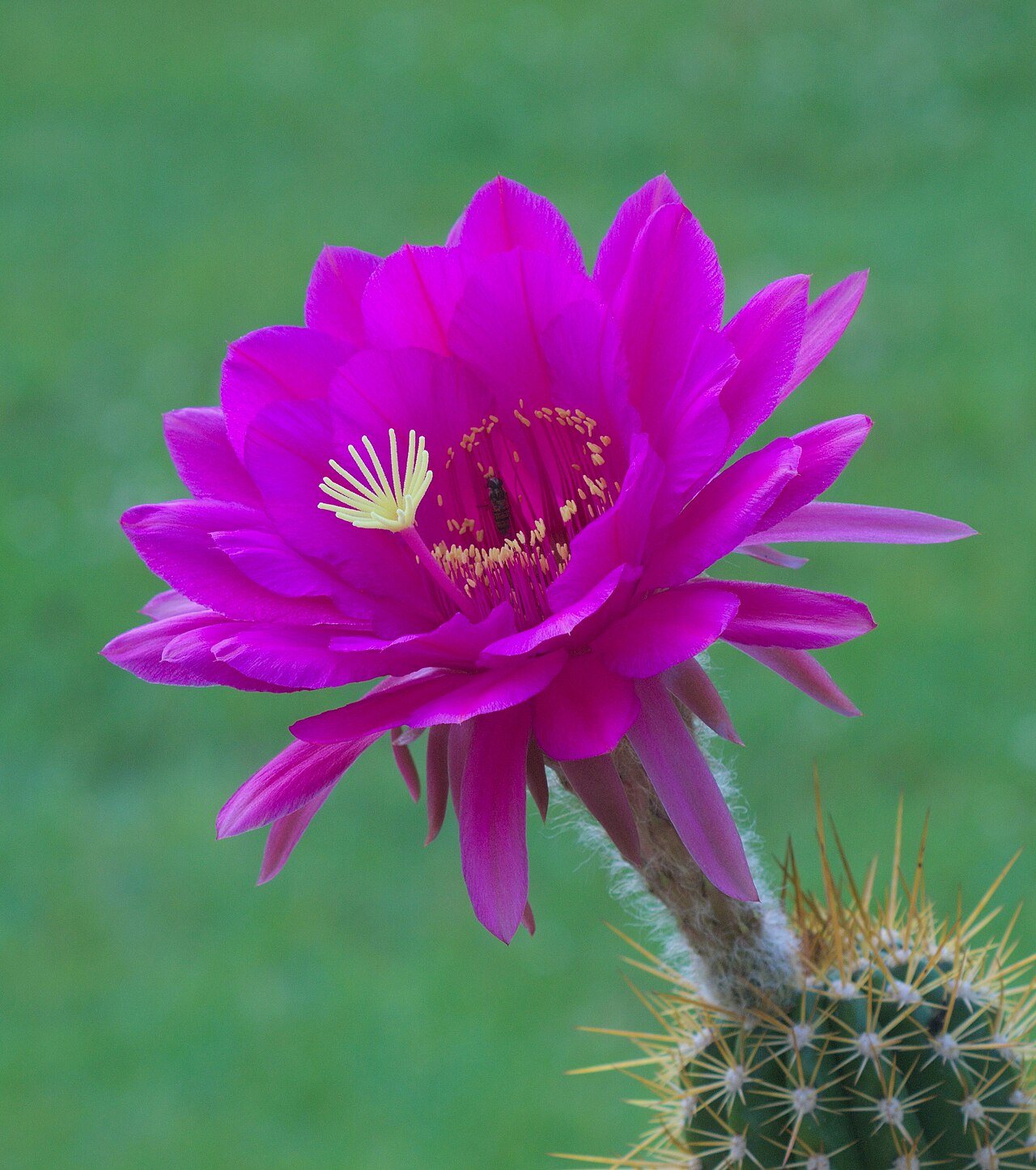
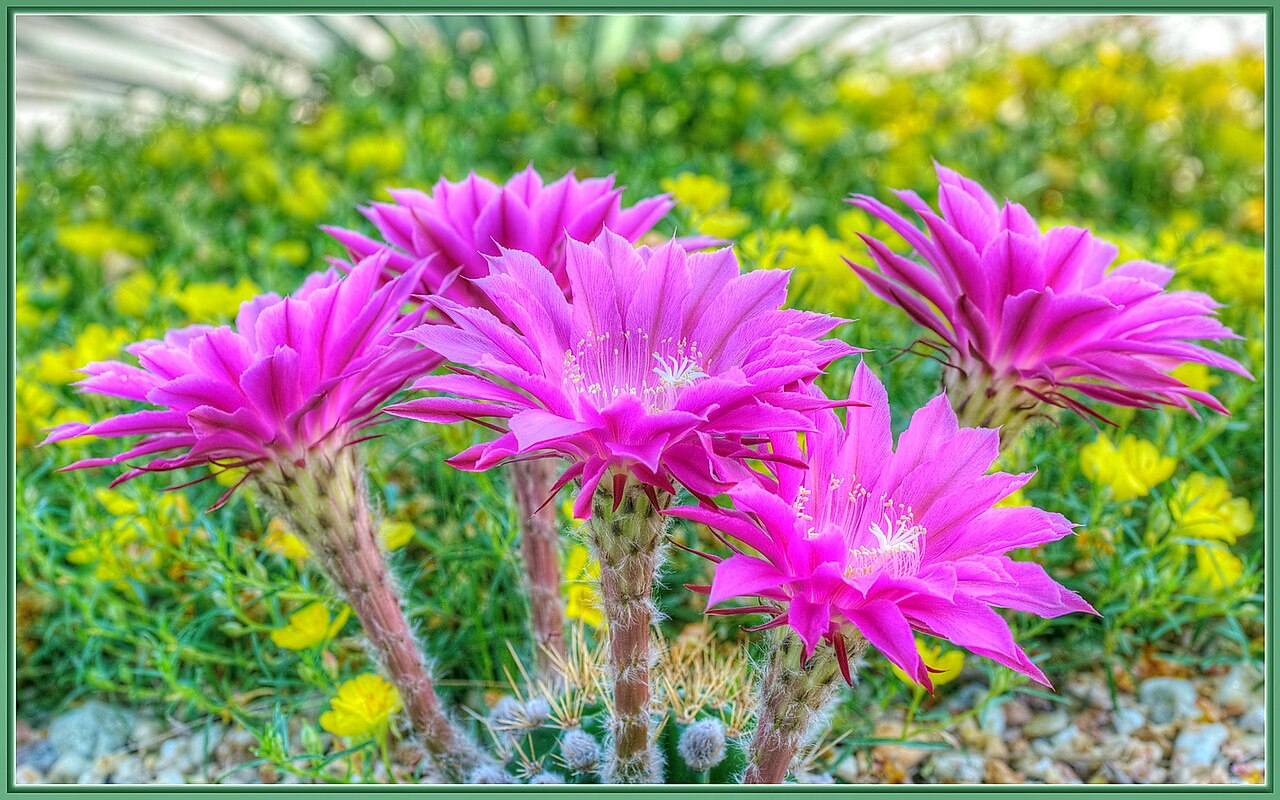
Two historic California breeding programs lie behind many named Trichocereus/Echinopsis flowering hybrids: Harry Johnson's "Paramount" hybrids, bred at Johnson Cactus Gardens in Paramount, California — roughly 26 officially named crosses between 1954 and 1968, including 'Red Paramount', 'Salmon Queen', 'Orange Glory' and 'Scarlet O'Hara' — and Bob Schick's later hybrids, which built on Johnson's stock and were introduced through The Huntington — see the dedicated Schick hybrids page. Other grower-named crosses in cultivation include the following.
| Cultivar | Originator or source | Parentage / origin | Notes |
|---|---|---|---|
| Echinopsis 'First Light' | Hybridized by Mark Dimmitt | Echinopsis 'Diehls' × Trichocereus 'Newlands Orange' | Bloom about 8 in. across: light pink inner petals with a darker pink mid-stripe, back petals darker pink. |
| 'Flying Saucer' | — | — | Extra-large blooms to 14 in. across when several buds are thinned; pink with orange mid-stripes and a pastel yellow throat. |
| 'LaLania' | — | — | Blooms about 6 in. across, orange with a touch of cerise and a darker orange mid-stripe; column to 10 in. diameter and 3–4 ft tall at maturity. |
| 'Orange California' | — | — | Bloom about 8 in. across, light orange to pink with a darker orange mid-stripe; plant 6–8 in. diameter and up to about 40 in. tall, tending to lean around 36 in. so may need support. |
| 'lumberjackius' | Sourced from grower Joe Lev, 2001 | Assessed as a T. peruvianus × bridgesii cross | Origin story traces to a purchase from a Lumberjack building-supply store in Rancho Cordova, California; fast growth with blue new growth. |
| T. pachanoi 'Juul's Giant' (TJG) | Tom Juul, San Francisco; first distributed by Cactus Gem Nursery | Single named garden clone | Full history on the pachanoi page. |
| T. pachanoi 'Torres & Torres' | Collected by Donna and Manuel Torres | Apparent wild specimen, northern Chile | Full history on the pachanoi page. |
| T. huanucoensis 'Don Huan' | Traced through Sacred Succulents and Serra Gardens to Ed and Betty Gay | — | A comparatively recent cultivar name in the collector record. |
Freaky Cacti · Harry Johnson's Paramount hybrids ↗ · Sacred Cactus · Joseph Harry Johnson, Paramount hybrids ↗ · San Pedro Cactus · Trichocereus named clones ↗
Cultivation
Choose space and care around the actual cross rather than a generic schedule — parentage, rootstock, age and local conditions all affect growth and seasonal needs. See the growing guide for general technique.
References
The Huntington · Schick hybrid records ↗ · LLIFLE · ×Trichopsis hybrids ↗ · Freaky Cacti · Harry Johnson's Paramount hybrids ↗ · Sacred Cactus · Joseph Harry Johnson, Paramount hybrids ↗ · San Pedro Cactus · Trichocereus named clones ↗ · Linda Hollingsworth (Bexar County Master Gardener), Trichocereus Hybrids