Quick facts
| Family | Cactaceae |
|---|---|
| Subfamily | Cactoideae |
| Tribe | Trichocereinae (subtribe of Cereeae), per the 2025 phylogenomic classification used elsewhere on this site; historically placed in the broader tribe Trichocereeae (Hunt et al., The New Cactus Lexicon, 2006). |
| Genus | Echinopsis Zucc. — Trichocereus (A.Berger) Riccob. (1909) is treated as a genus-rank synonym under Kew's primary treatment. |
| Accepted name (Kew) | Echinopsis pachanoi (Britton & Rose) H.Friedrich & G.D.Rowley, I.O.S. Bull. 3: 96 (1974) |
| Synonyms | Trichocereus pachanoi Britton & Rose, Cact. 2: 134 (1920), homotypic (the original combination); Cereus pachanoi (Britton & Rose) Werderm. (1931), homotypic; Trichocereus macrogonus var. pachanoi (Britton & Rose) Albesiano & R.Kiesling (2012), homotypic; Trichocereus macrogonus subsp. pachanoi (Britton & Rose) Lodé (2024), homotypic per Kew (a valid subspecies under Lodé's separate Trichocereus genus concept); Trichocereus macrogonus subsp. sanpedro M.H.J.van der Meer (2022), homotypic; plus heterotypic synonyms Echinopsis santaensis, E. schoenii, Trichocereus santaensis, T. schoenii and T. torataensis. |
| Common names | San Pedro cactus |
| Native range | Ecuador and Peru (southern Ecuador to Peru). Introduced in Bolivia, the Canary Islands, central Chile, Colombia and Spain. |
| Conservation status | IUCN Least Concern, population stable (Ostolaza, Cáceres & Roque, 2017; Red List 2017: e.T152445A121474583). CITES Appendix II, as for the whole family Cactaceae. |
Description
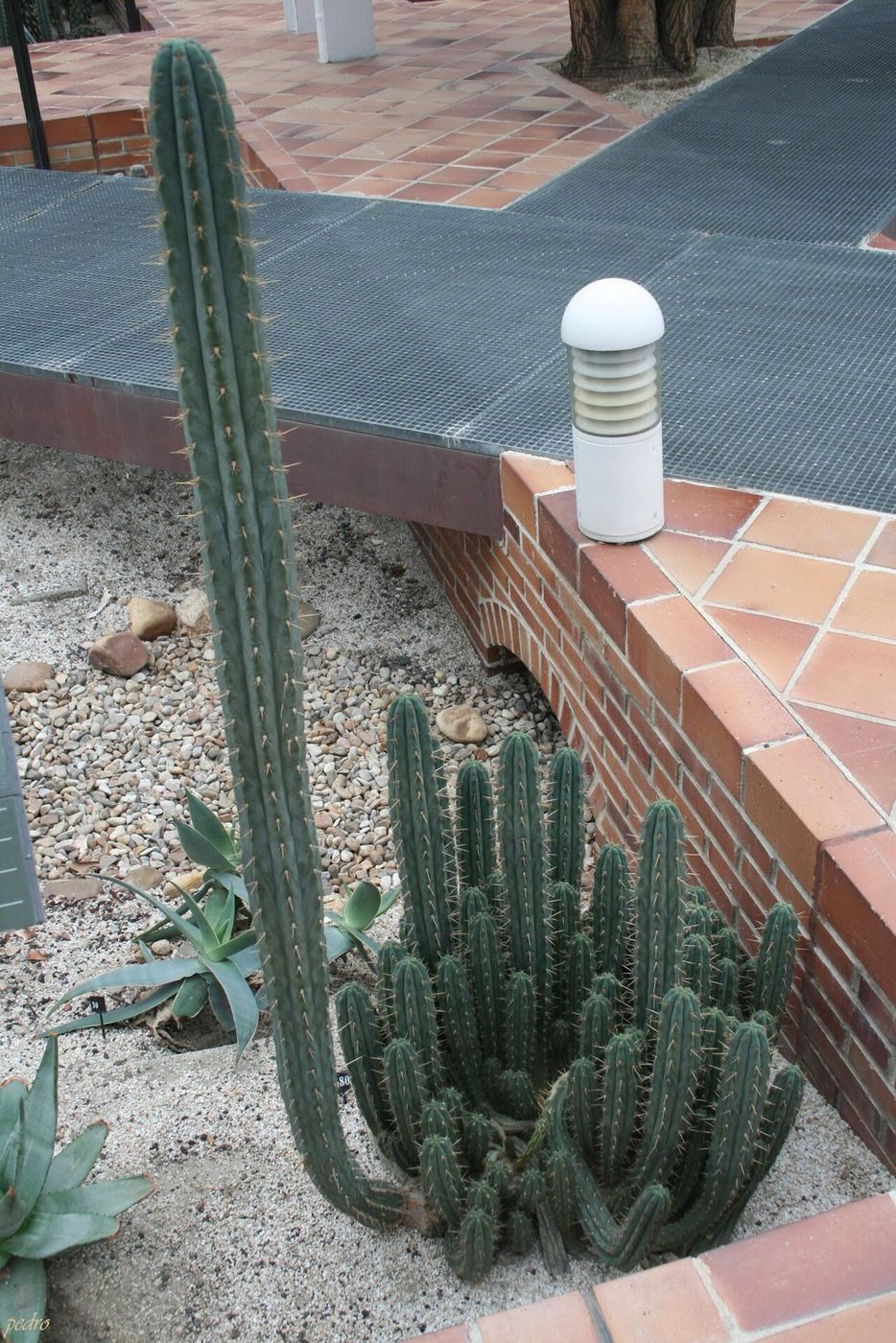
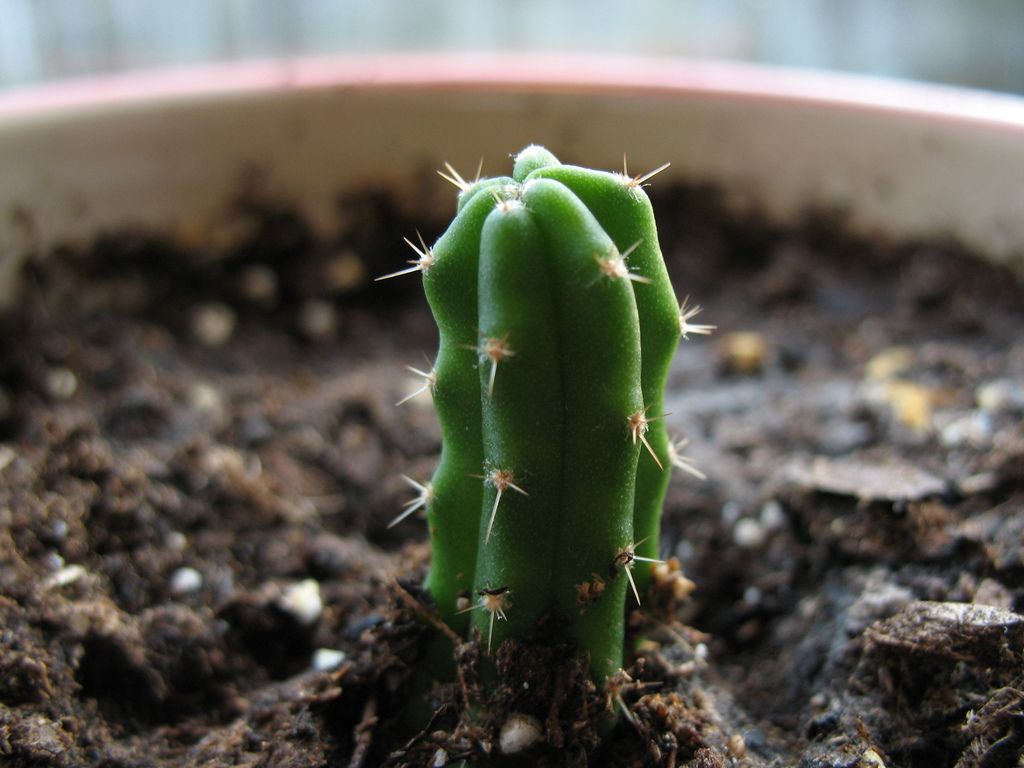
Britton and Rose (1920) described an upright, branching cactus with six to eight broad ribs, often few or no spines, and very large, fragrant white flowers opening at night; young stems were slightly glaucous, becoming darker green with age. Their name honors Abelardo Pachano.
Stem and ribs
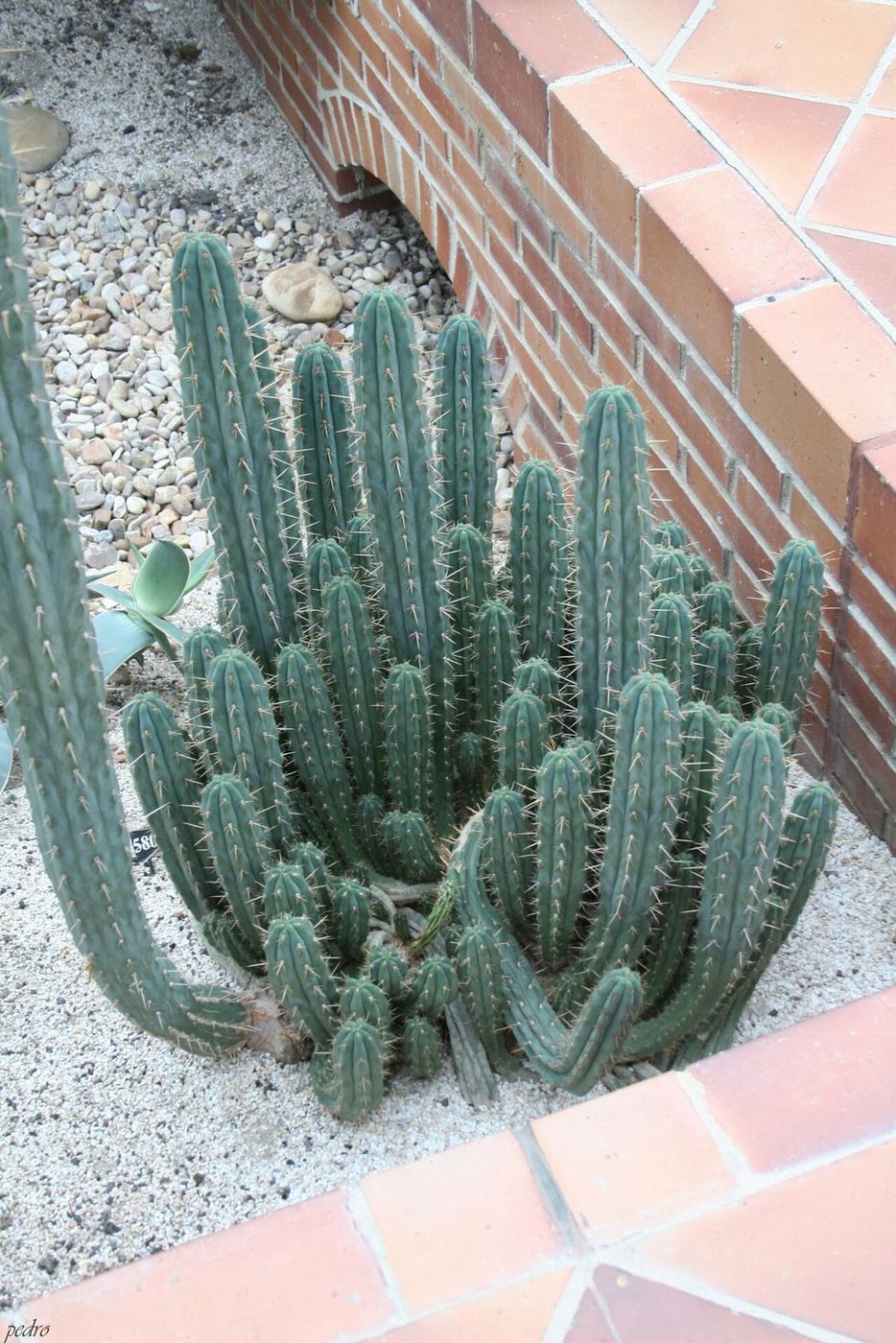
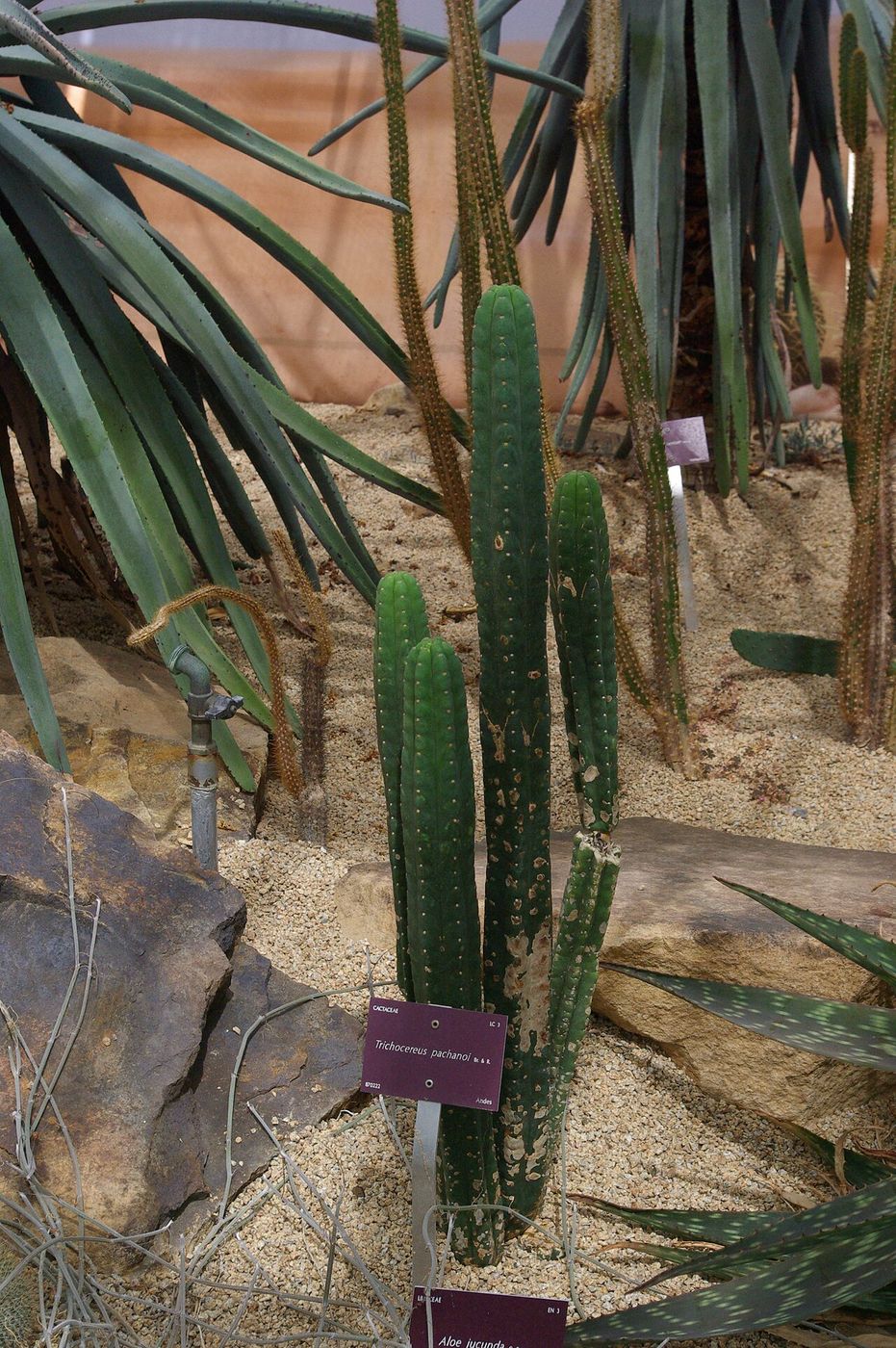
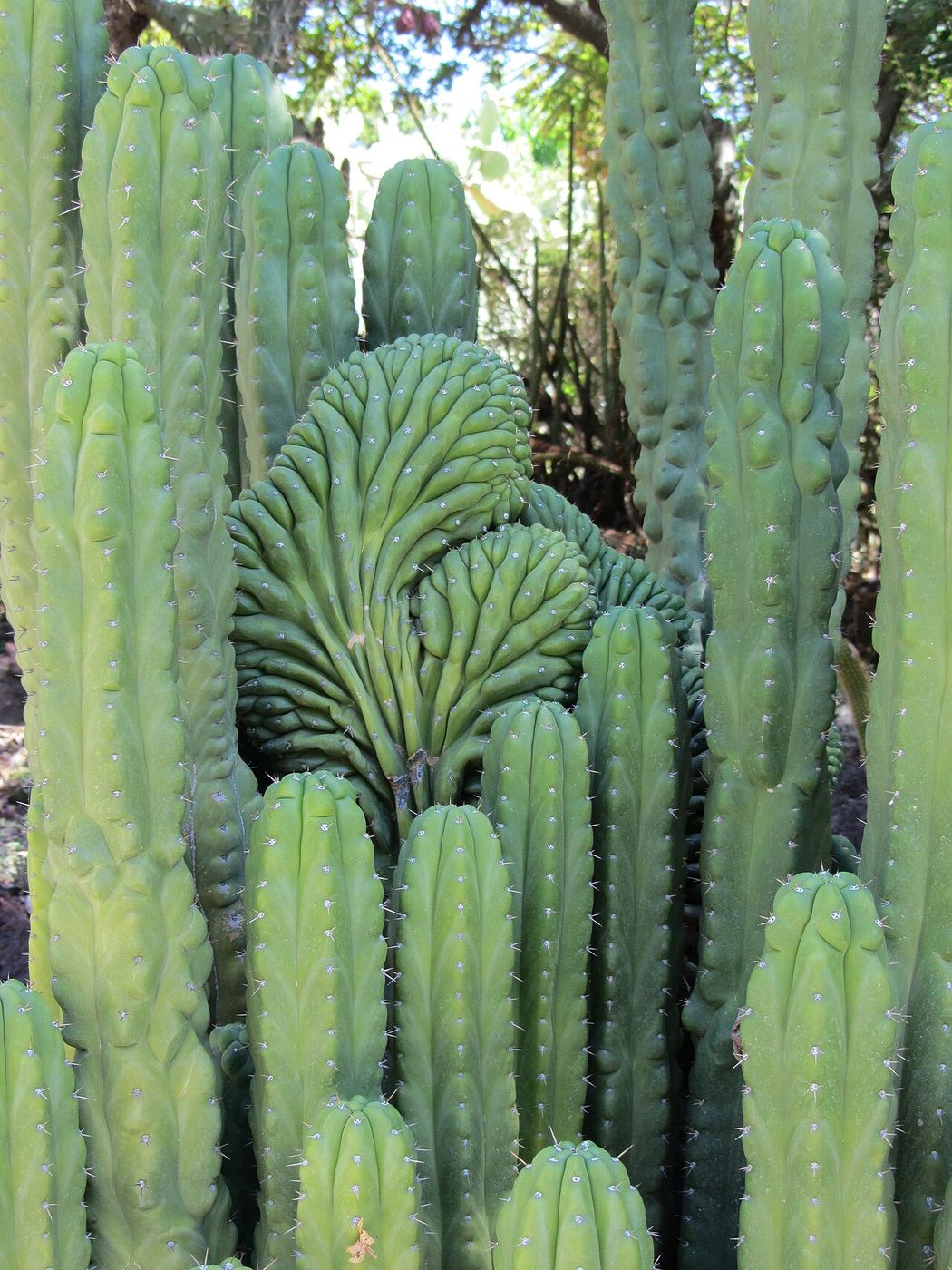
Upright, freely branching columnar habit, usually with six to eight ribs. Stems are reported 6–15 cm across, light to dark green and sometimes lightly glaucous.
Areoles and spines
Areoles sit roughly 2 cm apart along each rib and typically carry up to seven spines, yellow ageing to brown, most under 2 cm long. Cultivated plants are frequently described as nearly spineless.
Flowers
Large, white and strongly fragrant, opening at night, reported 19–24 cm long with a bloom diameter up to 20 cm, lasting about two days before closing.
Size
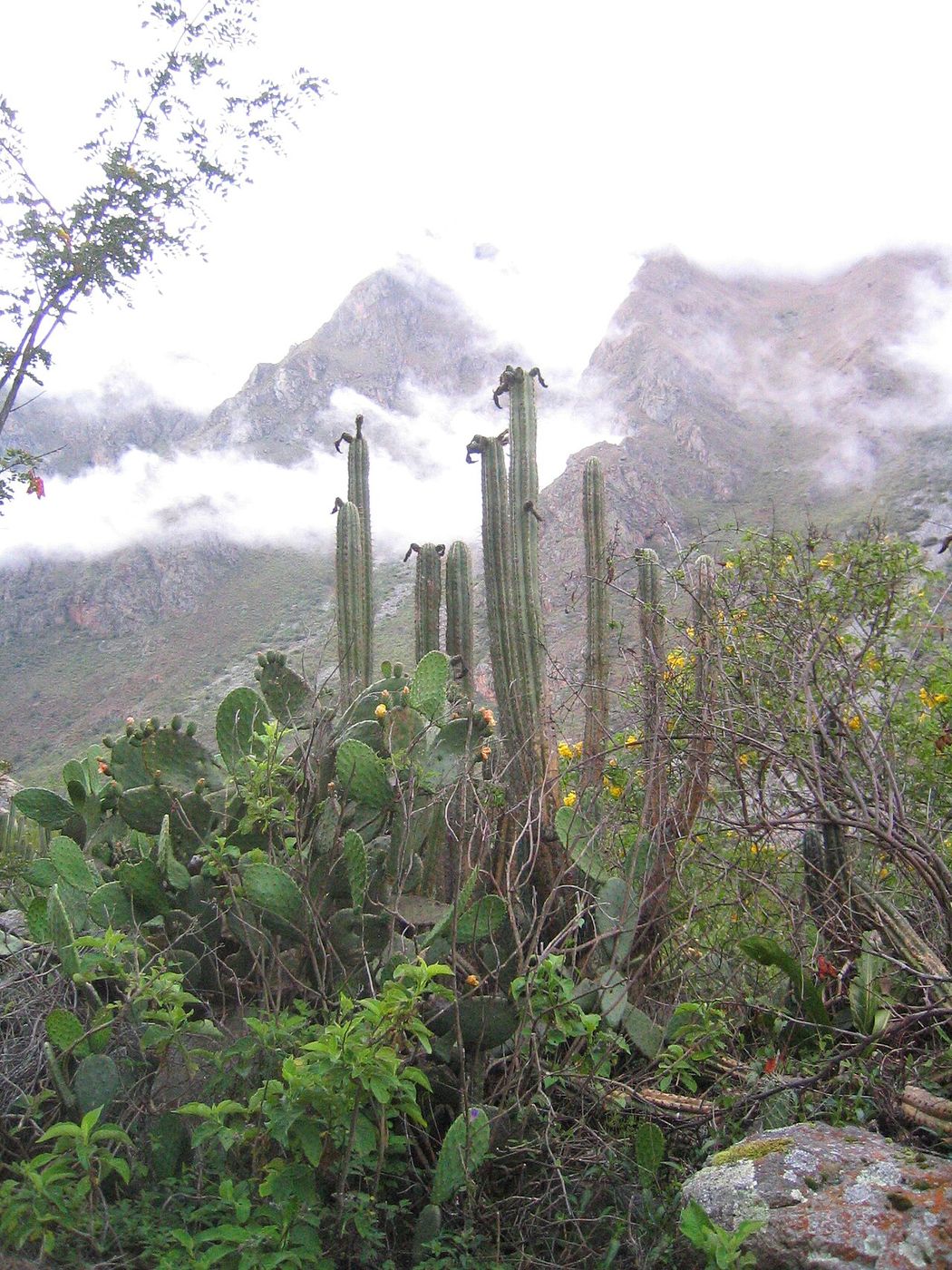
Established plants are reported reaching 3–6 m, occasionally taller, branching mainly from the base.
Britton & Rose · The Cactaceae, volume 2 (1920), pp. 134–140 ↗ · Wikipedia · Trichocereus macrogonus var. pachanoi ↗
Distribution and habitat
Native to Ecuador and Peru, from southern Ecuador into Peru (POWO). Recorded as introduced elsewhere, including Bolivia, the Canary Islands, central Chile, Colombia and Spain — those introduced records are distinct from the native range.
Similar species
Spine length and stem color are the field cues cited most often, though neither settles an identification alone. Compare against peruvianus, usually reported with a more pronounced blue-frosted stem and longer spines, and bridgesii, whose spines are consistently reported much longer and more numerous per areole. Rib counts overlap across all three, so they are not a reliable sole distinguisher.
Cultivation
The ranges below are reported starting points gathered from cultivation sources, not a fixed schedule — adjust to your own climate, pot size and season.
| Factor | What sources report |
|---|---|
| Light | Full sun once acclimated; ease new or winter-dulled plants into strong spring sun gradually to avoid scorch. |
| Soil | A free-draining, mineral-heavy mix is generally recommended. See the soil mix guide. |
| Watering | Resume with active spring growth, water more generously through summer while letting the mix dry fully between waterings, then withhold through winter dormancy. See the seasonal care guide. |
| Temperature | Reported as hardy to roughly USDA zone 8b (winter lows near −9 °C) when kept dry, and more reliably in zones 9–10; wet cold is consistently described as more damaging than dry cold. |
| Propagation | Propagates readily from stem cuttings, which root on as genetic clones of the parent plant. See the propagation guide. |
| Growth | Described as fast for a columnar cactus, with reports of up to 30 cm of new growth a year under good conditions. |
| Use as grafting stock | Widely used as understock — described as vigorous, short-spined and easy to handle for general grafts. See the grafting guide. |
Wikipedia · Trichocereus macrogonus var. pachanoi ↗ · BCSS · General cactus cultivation advice ↗ · Cactocereus · Grafting cactus 101 ↗
Cultivars and forms
A botanical synonym names the whole species; a clone or cultivar name names one individual plant and its vegetative descendants. Grower-named selections documented for this species include the following.
| Clone or cultivar | Originator or source | Parentage / origin | Notes |
|---|---|---|---|
| 'PC' ("Pachanot") | Name coined and popularized by Keeper Trout (Trout's Notes) | Propagated vegetatively as a single widespread clone; not documented from the wild | The predominant pachanoi-type clone in US horticulture; see the dedicated page for its competing origin theories. |
| 'Juul's Giant' (Tom Juul's Giant, TJG) | Tom Juul, San Francisco; first distributed by Cactus Gem Nursery | Single named garden clone | After Juul died, grower "Kakster" saved cuttings before the garden was cleared and distributed them; Sacred Succulents later distributed the authenticated clone widely. The name was later misapplied to other girthy pachanoi, so collectors mark confirmed lineage as "Tom Juul's Giant Yard" or "SS TJG." |
| 'Torres & Torres' | Collected by Donna and Manuel Torres | Apparent wild specimen, northern Chile — outside the species' standard range | Distinct from an unrelated "Texas Torch" relabeling introduced by Creekside Nursery around 2017. |
| Hutchison 1597 / Hutchison 6212 | Paul C. Hutchison field collections | Berkeley Botanical Garden accessions BBG 57.0884 and BBG 64.0762 | The 6212 line has been kept in cultivation via Sacred Succulents since the original Berkeley plant died. |
San Pedro Cactus · Trichocereus named clones ↗ · Diablo Valley Farm · Trichocereus info ↗
Taxonomy and names
Trichocereus pachanoi, Echinopsis pachanoi and Trichocereus macrogonus var. pachanoi are the same nomenclatural type under three different combinations: Trichocereus pachanoi Britton & Rose (1920) is the original combination, Echinopsis pachanoi (Britton & Rose) H.Friedrich & G.D.Rowley (1974) is Kew's current accepted name, and the var. pachanoi combination is a later, different-rank treatment of the same type. Sharing a type ("homotypic") means the names are nomenclaturally linked, not that every living plant sold under any of them is genetically identical — keep the botanical name and an individual plant's provenance in separate fields. See the lineage guide.
Kew's accepted name is an attributed taxonomic treatment, not a universal name every author must follow. Joël Lodé's competing classification keeps the genus Trichocereus separate from Echinopsis and treats this plant as Trichocereus macrogonus subsp. pachanoi rather than folding it into Echinopsis pachanoi. Whether "pachanoi" is best treated as its own species or as part of a broader Trichocereus/Echinopsis macrogonus complex remains an open naming question among sources. Growers overwhelmingly continue to search for and sell this plant as "Trichocereus pachanoi," which is why that name is kept as this page's heading; see Trichocereus / Echinopsis for the wider genus-level picture.
Conservation and legal status
IUCN Red List: Least Concern, population stable. Assessed by Ostolaza, C., Cáceres, F. & Roque, J. (2017, an amended version of a 2013 assessment, originally assessed in 2011); IUCN Red List 2017: e.T152445A121474583.
CITES: the whole family Cactaceae, including this species, is listed on CITES Appendix II; pachanoi is not among the small set of cactus taxa singled out for the stricter Appendix I.
References
Britton & Rose · The Cactaceae, volume 2 (1920) ↗ · Kew POWO · Echinopsis pachanoi ↗ · Wikipedia · Trichocereus macrogonus var. pachanoi ↗ · BCSS · General cactus cultivation advice ↗ · Cactocereus · Grafting cactus 101 ↗ · IUCN Red List · Echinopsis pachanoi (2017) ↗ · San Pedro Cactus · Trichocereus named clones ↗ · Diablo Valley Farm · Trichocereus info ↗