Quick facts
| Family | Cactaceae |
|---|---|
| Subfamily | Cactoideae |
| Tribe | Trichocereinae (subtribe of Cereeae), per the 2025 phylogenomic classification used elsewhere on this site; historically placed in the broader tribe Trichocereeae (Hunt et al., The New Cactus Lexicon, 2006). |
| Genus | Echinopsis Zucc. — Trichocereus (A.Berger) Riccob. (1909) is treated as a genus-rank synonym under Kew's primary treatment. |
| Accepted name (Kew) | Echinopsis lageniformis (C.F.Först.) H.Friedrich & G.D.Rowley, I.O.S. Bull. 3: 96 (1974) |
| Synonyms | Trichocereus bridgesii (Salm-Dyck) Britton & Rose, Cact. 2: 134 (1920), heterotypic; Trichocereus scopulicola F.Ritter (1966) and Echinopsis scopulicola (F.Ritter) Mottram (1997), heterotypic; Trichocereus crassicostatus F.Ritter (1966), heterotypic per Kew; Trichocereus riomizquensis F.Ritter (1980), heterotypic. The oldest validly published name in this group is Cereus lageniformis C.F.Först. (1861) — the basionym, and why the accepted epithet is "lageniformis" rather than "bridgesii". |
| Native range | Bolivia. Introduced in the Canary Islands and Spain. |
| Conservation status | IUCN Least Concern, population unknown (Lowry, M., 2017; Red List 2017: e.T152817A121489925). CITES Appendix II, as for the whole family Cactaceae. |
Description
Britton and Rose (1920) described a branching columnar plant with pale-green, slightly glaucous stems, four to eight ribs and a few very unequal yellowish spines.
Stem and ribs
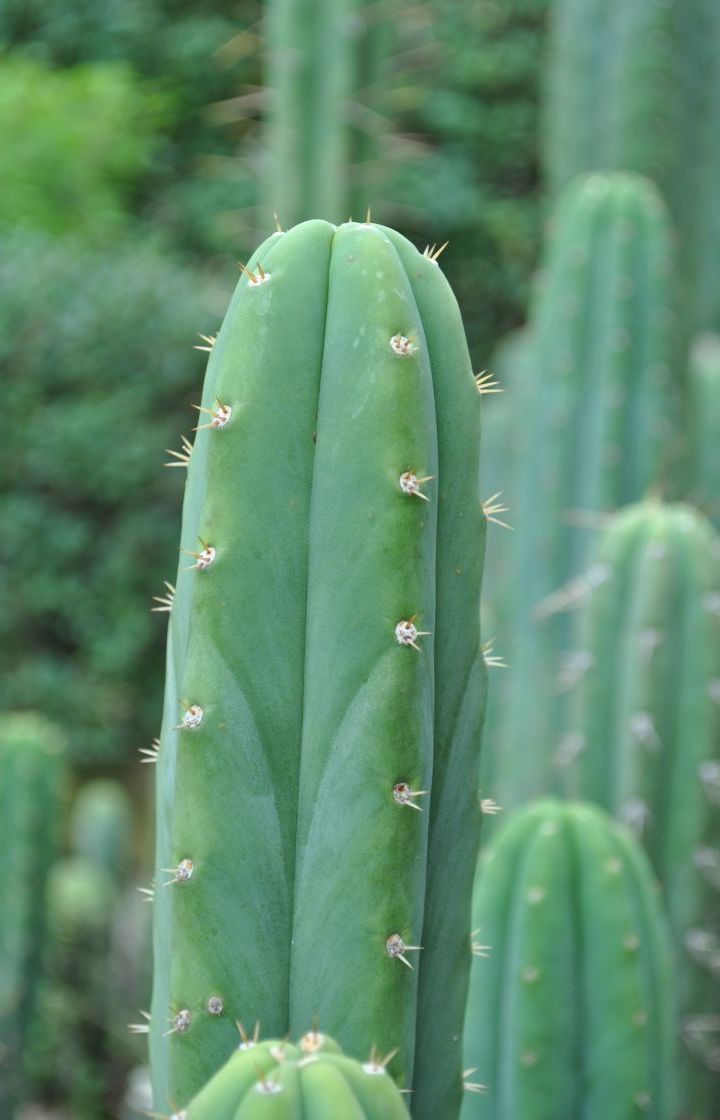
A fast-growing, often shrubby to small-tree-like columnar cactus, usually four to eight ribs (most commonly reported five to seven), pale to mid-green stems carrying a slight blue-grey cast. Mature stems are reported 10–20 cm across, with plants reaching 2–5 m.
Areoles and spines
Areoles sit roughly 2–3 cm apart and carry two to six spines per areole; reported spine length varies widely, from under 1 cm up to roughly 6–7 cm and occasionally to about 10 cm, honey-colored ageing to brown — among the longest-spined of the commonly cultivated Trichocereus/Echinopsis.
Flowers
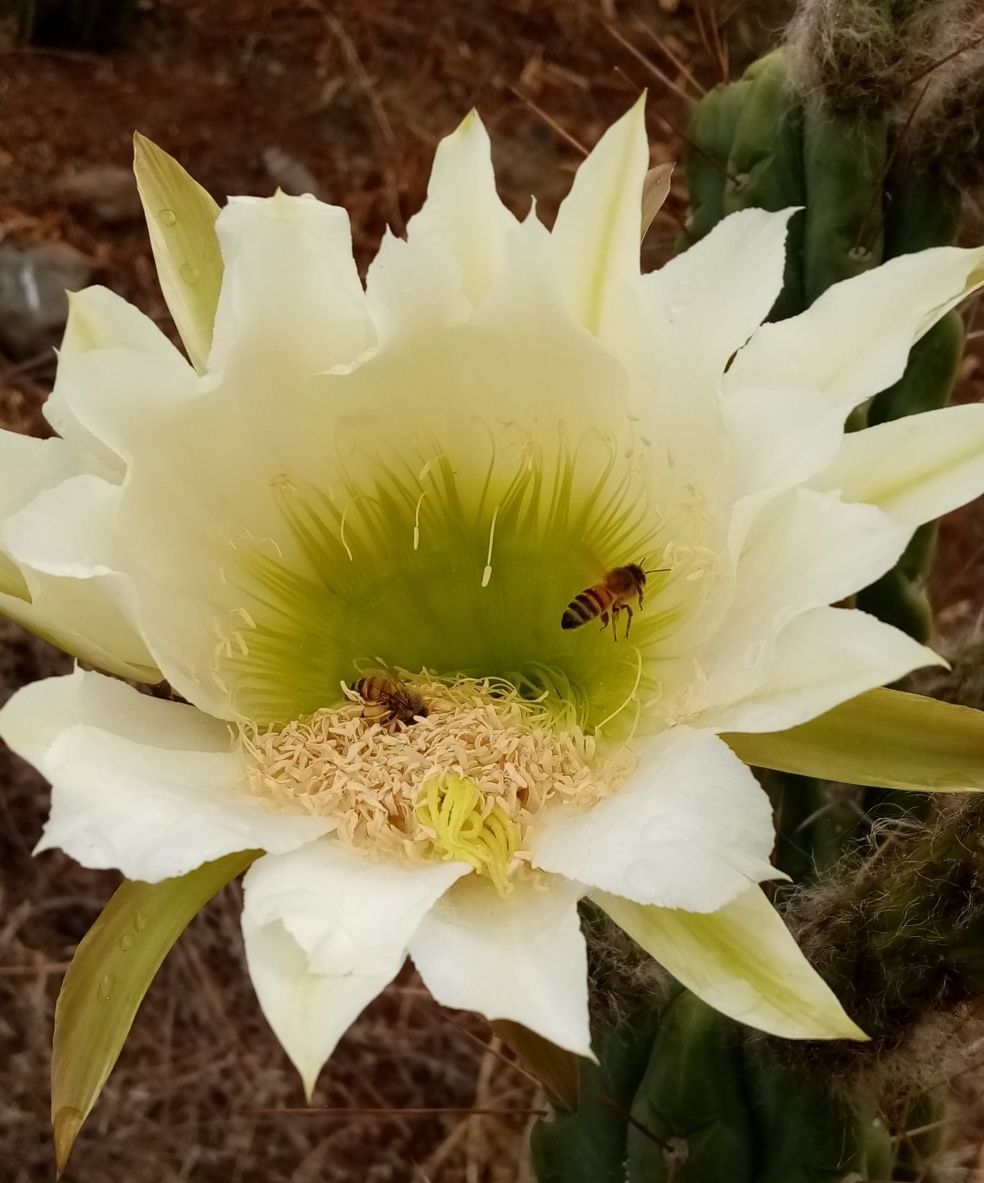
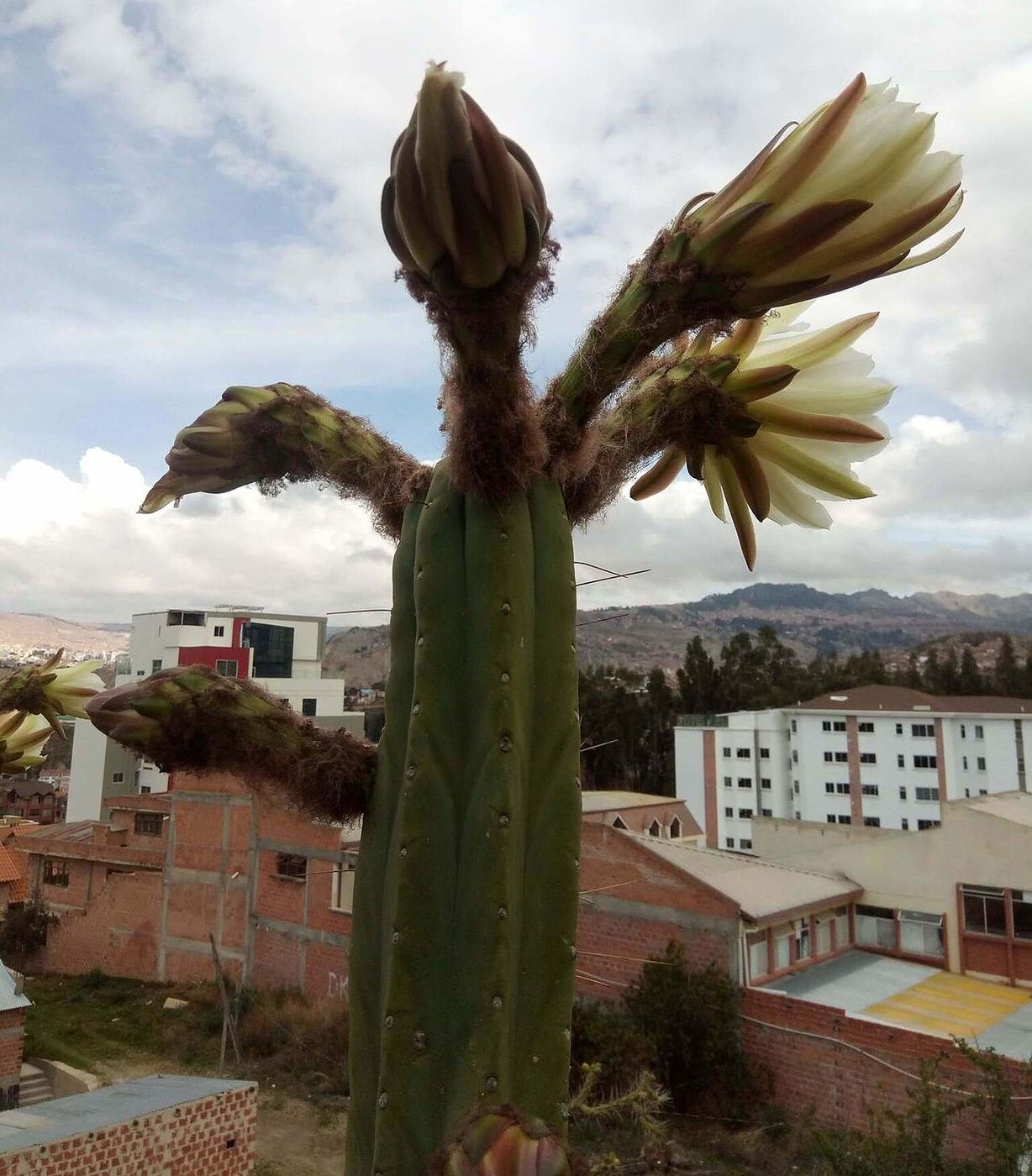
Large, white, night-opening and fragrant, reported around 15–18 cm long.
Britton & Rose · The Cactaceae, volume 2 (1920), pp. 134–140 ↗ · Wikipedia · Echinopsis lageniformis ↗ · Llifle · Cereus bridgesii ↗
Distribution and habitat
Native to Bolivia (POWO); recorded as introduced in the Canary Islands and Spain. A plant encountered in a market outside Bolivia is not, by itself, evidence of a native population there.
Similar species
Long, drooping spines are the character most often cited against pachanoi, which is usually far more sparsely spined, and against peruvianus, whose spines are typically shorter and whose stem color is more consistently blue. Four-ribbed plants are sometimes sold under names implying a fixed form, but sources note that rib count can vary within a single plant over time, so it is not a dependable identifier on its own.
Cultivation
The ranges below are reported starting points drawn from cultivation sources, not a fixed schedule — adjust for your own climate, pot size and season. Do not label every dark lesion "bridgesii black rot" or assume one pathogen: record whether tissue is firm or collapsing, whether damage spreads, and what changed in watering, temperature or handling; see the cactus health guide. Cold tolerance also depends on exposure duration, moisture and prior conditions, not on a single reported figure — protect plants from unfamiliar cold and track your own results.
| Factor | What sources report |
|---|---|
| Light | Full sun once acclimated; one grower reference recommends light shade during intense summer heat to prevent sunburn on established plants. |
| Soil | A fertile, free-draining mineral mix is generally recommended. See the soil mix guide. |
| Watering | Water well and let the mix dry before watering again; one source describes this species tolerating slightly more moisture than many columnar cacti in growth, but overwatering during cold weather is described as a fungal-disease risk. See the seasonal care guide. |
| Temperature | Sources vary: one grower reference reports hardiness to about −12 °C or lower when bone-dry, while related columnar Trichocereus/Echinopsis are more commonly described as damaged nearer −5 to −9 °C. Treat cold tolerance cautiously and prioritize dry roots over any single figure. |
| Propagation | Like related columnar Trichocereus/Echinopsis, propagates readily from stem cuttings. See the propagation guide. |
| Growth | Described as fast once established, with one source reporting about 30 cm of new growth a year under good feeding and watering. |
| Use as grafting stock | Less consistently documented as understock than pachanoi or peruvianus in the grafting sources reviewed here. See the grafting guide for general technique. |
Cactus-Art · Trichocereus bridgesii ↗ · Llifle · Cereus bridgesii ↗ · Cactocereus · Grafting cactus 101 ↗
Cultivars and forms
Two child pages cover named horticultural branches of this species: scopulicola, a distinct grower identity tied to one 1959 Ritter field collection, and bridgesii monstrose (TBM), an irregular growth form. Neither is a separate botanical species under the current Kew treatment. Named clones documented in the collector record for typical (non-monstrose) bridgesii include the following.
| Clone or cultivar | Originator or source | Parentage / origin | Notes |
|---|---|---|---|
| SS02 | Sacred Succulents | — | — |
| 'Species C' | — | — | Also recorded as Trichocereus sp. "Unknown C" in Trout's Notes. |
| 'Eileen' | — | — | — |
| RS0005 | Grower Kakster | — | — |
| 'Psycho0' | — | — | An Australian cultivar. |
| SFBG | San Francisco Botanical Garden (Strybing Arboretum) plant sale, 2001 | — | — |
Taxonomy and names
Kew's accepted name is Echinopsis lageniformis (C.F.Först.) H.Friedrich & G.D.Rowley (1974). Trichocereus bridgesii (1920), Trichocereus scopulicola (1966) and Trichocereus crassicostatus (1966) are all heterotypic synonyms — different nomenclatural types folded into one species, not the same plant under three names. The oldest validly published name for this group is Cereus lageniformis C.F.Först. (1861), which is why the accepted epithet is "lageniformis" even though "bridgesii" is the name almost all growers use.
This taxonomic grouping does not establish that a bridgesii cutting and a named scopulicola selection are the same clone. Keep the horticultural distinction visible: record the supplied name and provenance for each plant rather than treating the species-level merger as proof of shared identity.
Conservation and legal status
IUCN Red List: Least Concern, population unknown. Assessed by Lowry, M. (2017, an amended version of a 2013 assessment, originally assessed in 2010); IUCN Red List 2017: e.T152817A121489925.
CITES: the whole family Cactaceae, including this species, is listed on CITES Appendix II; it is not among the small set of cactus taxa singled out for the stricter Appendix I.
References
Britton & Rose · The Cactaceae, volume 2 (1920) ↗ · Kew POWO · Echinopsis lageniformis ↗ · Wikipedia · Echinopsis lageniformis ↗ · Llifle · Cereus bridgesii ↗ · Cactus-Art · Trichocereus bridgesii ↗ · Cactocereus · Grafting cactus 101 ↗ · IUCN Red List · Echinopsis lageniformis (2017) ↗ · San Pedro Cactus · Trichocereus named clones ↗