Quick facts
| Family | Cactaceae |
|---|---|
| Subfamily | Cactoideae |
| Tribe | Trichocereinae (subtribe of Cereeae), per the 2025 phylogenomic classification used elsewhere on this site; historically placed in the broader tribe Trichocereeae (Hunt et al., The New Cactus Lexicon, 2006). |
| Genus | Echinopsis Zucc. — Trichocereus (A.Berger) Riccob. (1909) is treated as a genus-rank synonym under Kew's primary treatment. |
| Accepted name (Kew) | Echinopsis macrogona (Salm-Dyck) H.Friedrich & G.D.Rowley, I.O.S. Bull. 3: 96 (1974) |
| Synonyms | Trichocereus peruvianus Britton & Rose, Cact. 2: 136 (1920), heterotypic; Echinopsis peruviana (Britton & Rose) H.Friedrich & G.D.Rowley (1974), heterotypic; Trichocereus macrogonus (Salm-Dyck) Riccob. (1909), homotypic — this is the name accepted under Albesiano's 2012 "alternative taxonomy"; Trichocereus macrogonus var. peruvianus (Britton & Rose) Lodé (2012/2013); Trichocereus macrogonus subsp. peruvianus (Britton & Rose) Lodé (2024); Trichocereus pachanoi f. peruvianus (Britton & Rose) F.Ritter (1981). |
| Native range | Bolivia and Peru (western and southern Peru to Bolivia). Introduced in the Balearic Islands, the Canary Islands, Colombia and Spain. |
| Conservation status | Not evaluated (IUCN). CITES Appendix II, as for the whole family Cactaceae. |
Description
Britton and Rose (1920) described stout, upright or ascending branches, blue-waxed young growth, six to eight rounded ribs and robust brown spines, from material collected near Matucana, Peru, in 1914; mature flowers were not seen for that original description.
Stem and ribs
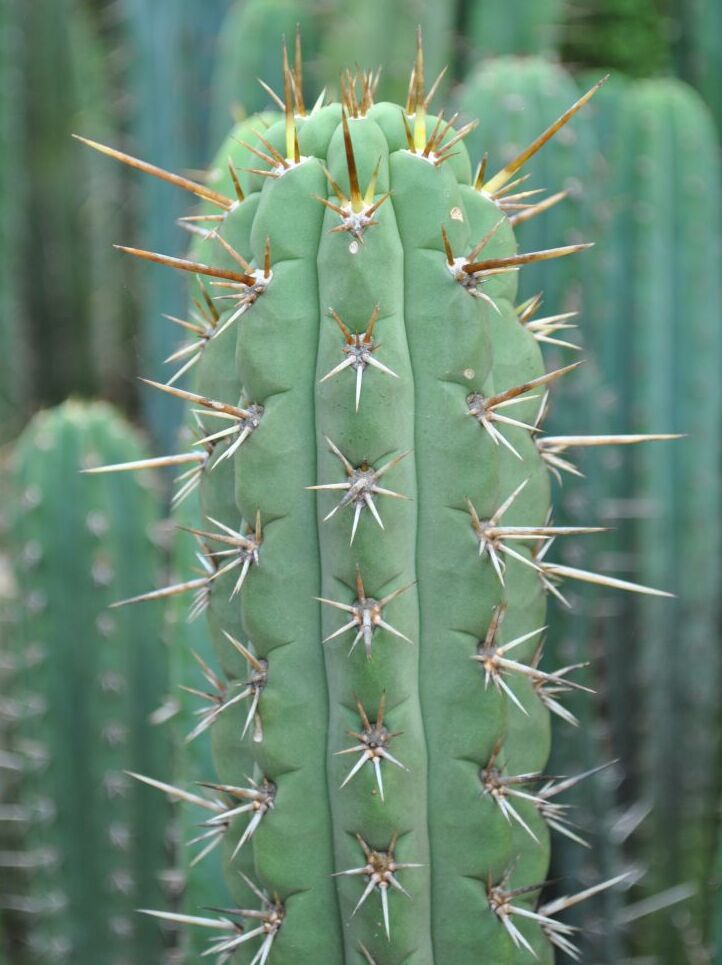
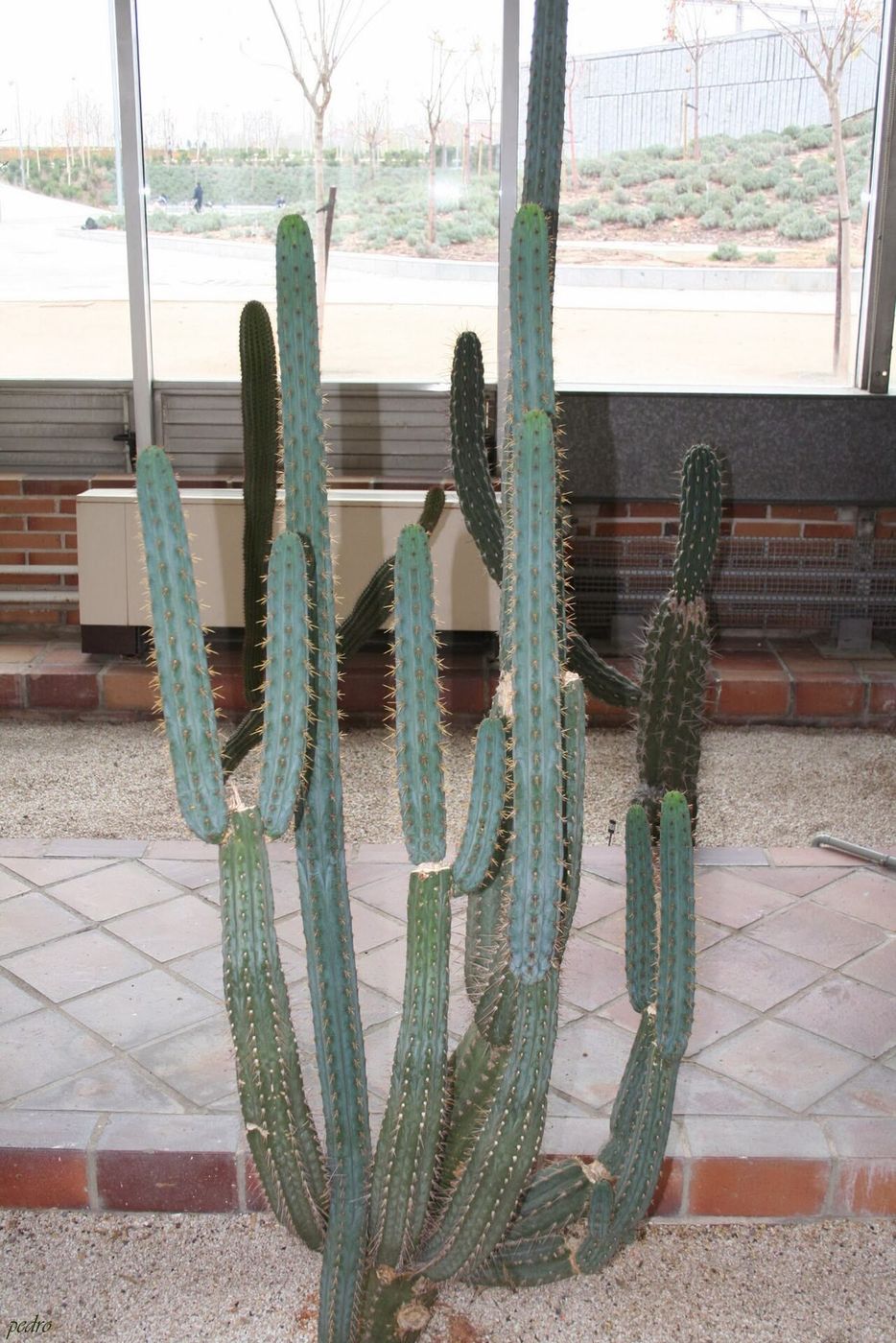
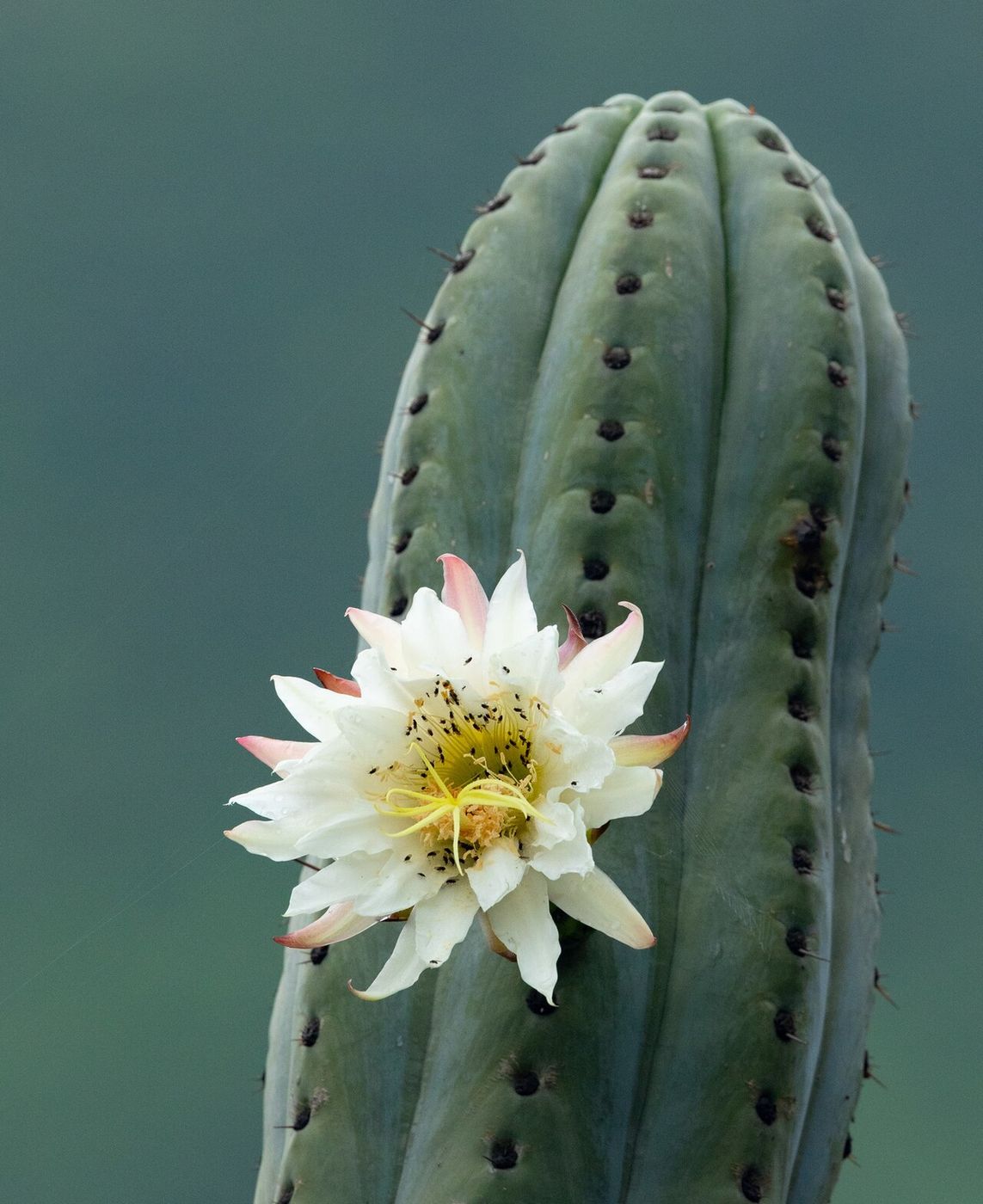
Erect columnar habit, generally six to eight ribs (occasionally five or nine), with bluish-green stems reported 6–15 cm across, occasionally more.
Areoles and spines
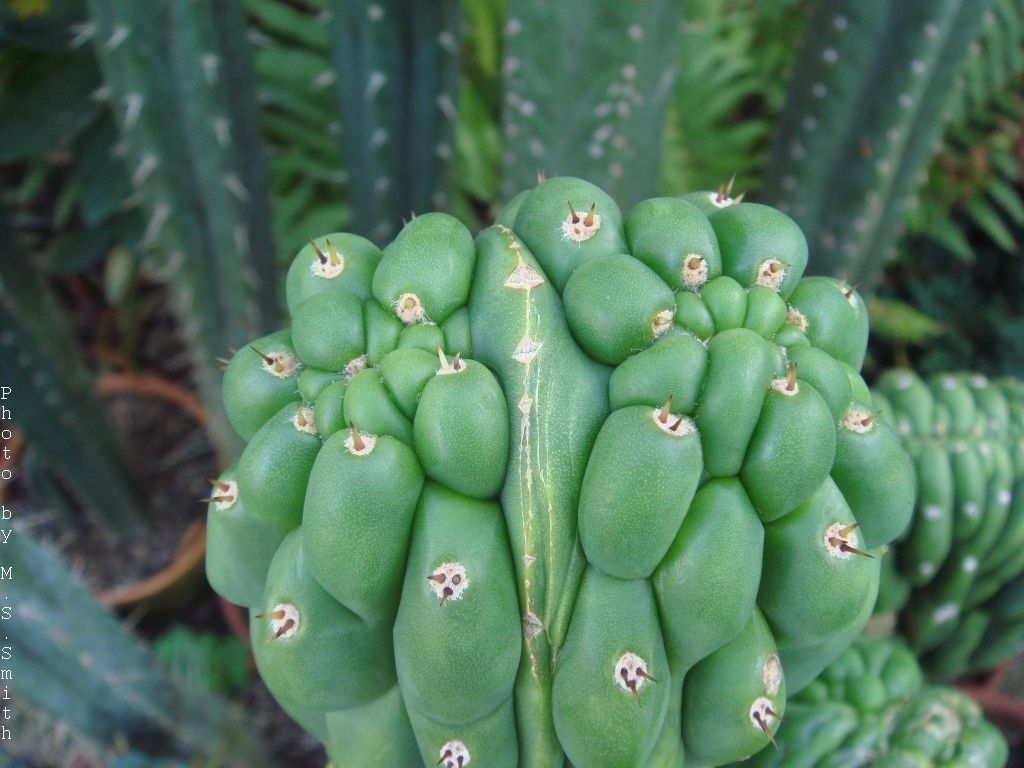
Older areoles can carry up to twenty spines, with three or four longer, more robust central spines reported up to about 5 cm and darker toward the tip; younger or more shaded plants are often described with far fewer, shorter spines. Areoles are spaced more than 2.5 cm apart.
Flowers
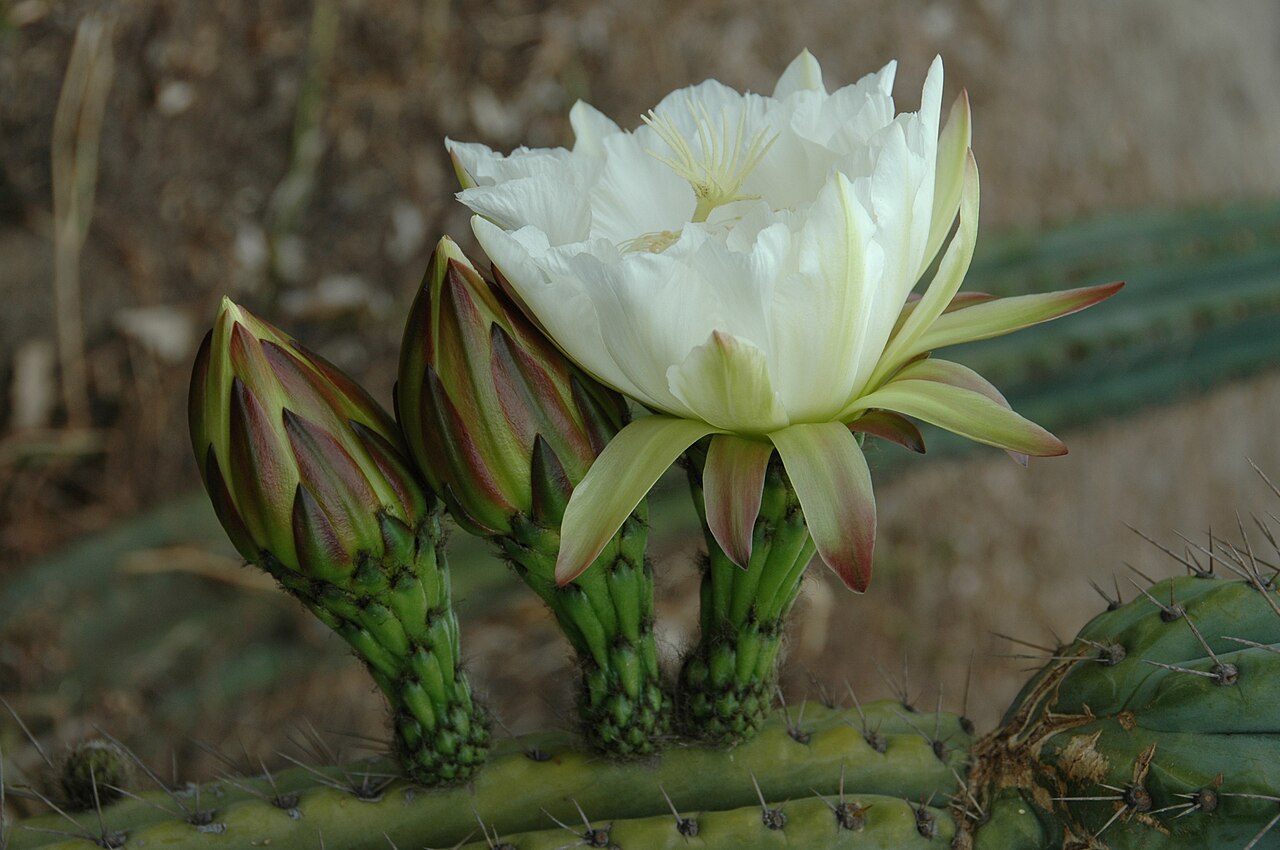
Carried mostly near the stem tips, reported up to about 21 cm long, with tepals described as pale yellow or yellowish-green, rarely pink — a departure from the white flowers typical of pachanoi and bridgesii.
Size
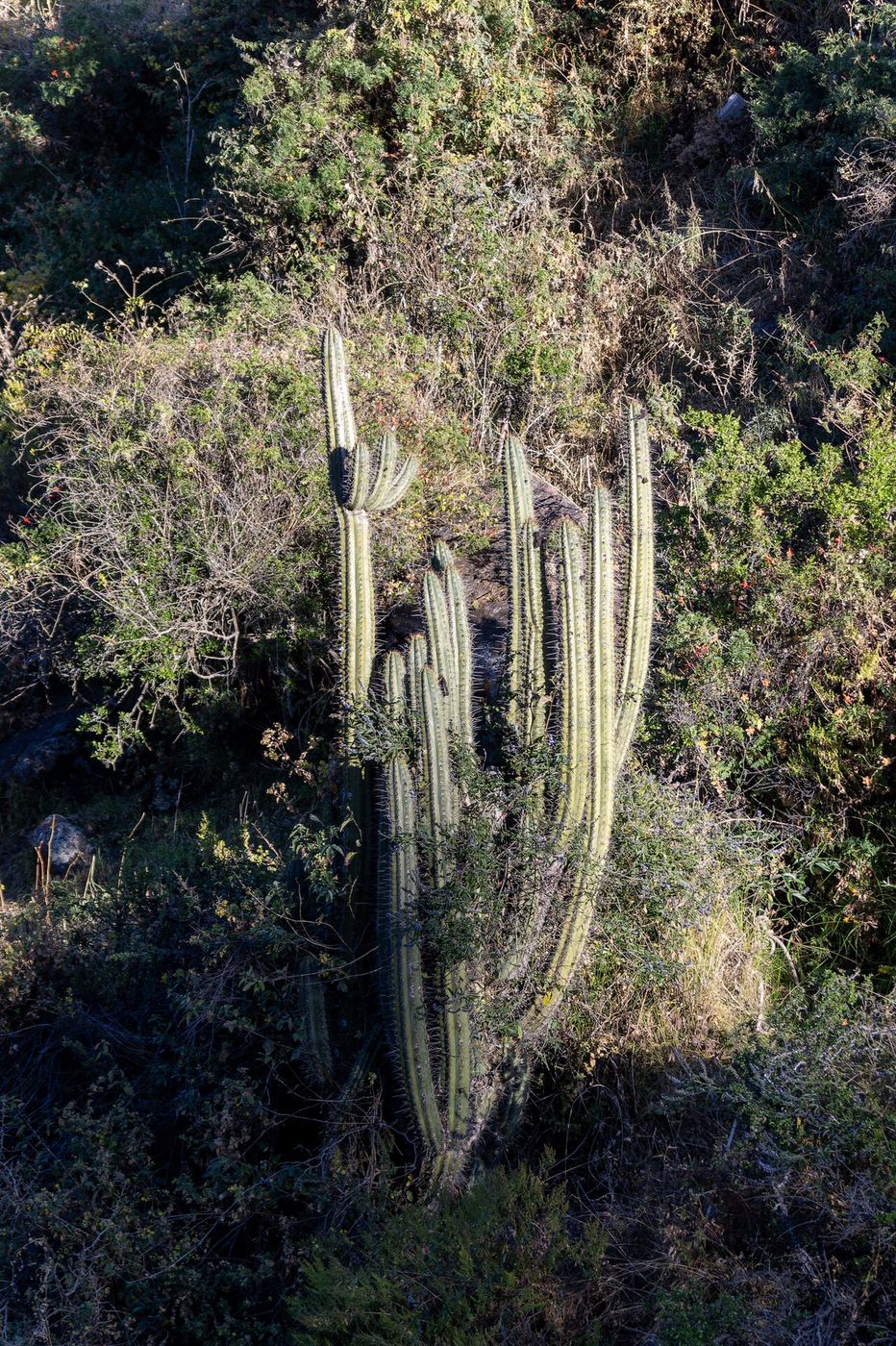
Established plants are reported reaching 2.5–5 m.
Britton & Rose · The Cactaceae, volume 2 (1920), pp. 134–140 ↗ · Wikipedia · Echinopsis macrogona ↗
Distribution and habitat
Native to Bolivia and Peru — western and southern Peru into Bolivia (POWO). Recorded as introduced in the Balearic Islands, the Canary Islands, Colombia and Spain.
Similar species
A blue-frosted stem and yellowish rather than white flower color are the characters most often cited to separate peruvianus-labeled plants from pachanoi and bridgesii, though flower color can be hard to confirm without seeing a plant bloom, and spine count is reported to increase substantially with age and light exposure — a young, shaded plant can look nearly spineless. Because Kew's current treatment folds peruvianus, Trichocereus macrogonus and several other historical names into one species, matching a garden label to a precise wild population is often not possible from morphology alone.
Cultivation
The ranges below are reported starting points drawn from cultivation sources, not a fixed schedule — adjust for your own climate, pot size and season.
| Factor | What sources report |
|---|---|
| Light | A sunny position is generally recommended; ease winter-dulled or newly potted plants into strong spring sun gradually to avoid scorch. |
| Soil | A well-drained, roughly neutral, mineral-rich mix is generally recommended. See the soil mix guide. |
| Watering | Sources describe keeping plants more or less dry through the dormant season and watering more freely in active growth, letting the mix dry between waterings. See the seasonal care guide. |
| Temperature | Reported as moderately cold-tolerant — able to survive short periods to about −9 °C when kept dry, but generally described as needing a mean annual temperature of at least 10 °C to thrive. |
| Propagation | Like related columnar Trichocereus/Echinopsis (for example pachanoi), propagates readily from stem cuttings. See the propagation guide. |
| Growth | Growth rate is not well documented in the sources reviewed for this page; treat it as a moderately fast-growing columnar cactus like its close relatives unless local experience says otherwise. |
| Use as grafting stock | Described as a useful, vigorous graft stock, though its spines are noted as making handling harder than smoother-spined relatives. See the grafting guide. |
Useful Tropical Plants · Trichocereus macrogonus ↗ · Wikipedia · Trichocereus macrogonus var. pachanoi ↗ · Cactocereus · Grafting cactus 101 ↗
Cultivars and forms
A seed-source reference is not a unique clone identifier. The GeeBee reference shows how several distinct garden names can share one source reference; retain the full label rather than shortening it to a single code. Named crosses involving this plant, such as 'lumberjackius' (a peruvianus × bridgesii cross), are covered on the Trichocereus hybrids page. Named clones documented in the collector record include the following.
| Clone or cultivar | Originator or source | Parentage / origin | Notes |
|---|---|---|---|
| RS0001 / RS0002 / RS0003 | Collector code tracked by grower "Kakster" | — | Likely a single clone or siblings rather than three distinct selections. |
| 'Fastest' (Verne's / Mallacht's Short Spine Peruvianus) | Grower Verne | — | Short-spined selection, also circulated under grower Mallacht's name. |
| 'Glaucus' and "Verne's Rimac" | Grower Verne | — | — |
| 'Big Mac' | The Jiimz family | — | — |
| 'Jessica' | Bought from an eBay seller named Jessica | — | Later reassessed as a form of Trichocereus puquiensis rather than T. peruvianus. |
Taxonomy and names
Kew's accepted name for this plant is Echinopsis macrogona (Salm-Dyck) H.Friedrich & G.D.Rowley (1974), native to Bolivia and Peru. Trichocereus peruvianus Britton & Rose (1920) and Echinopsis peruviana (Britton & Rose) H.Friedrich & G.D.Rowley (1974) are both heterotypic synonyms of it; Trichocereus macrogonus (Salm-Dyck) Riccob. (1909) is the homotypic synonym of the same accepted name (sharing a type with Cereus macrogonus Salm-Dyck, 1850) and is itself the accepted name under Albesiano's 2012 "alternative taxonomy" cited by Kew. All of these names — peruvianus, macrogonus, macrogona and peruviana — converge on one Kew-recognized species.
Despite that taxonomic merger, growers keep "peruvianus" and "macrogonus" as distinct horticultural identities, because the two names circulate in cultivation with different source populations, named selections and seed-lot histories, even though Kew currently treats them as one species. A taxonomic merger does not establish which seed population or named clone a particular nursery plant descends from — see the GeeBee reference and preserve the received name and its later determination separately. Joël Lodé's competing classification keeps the genus Trichocereus separate from Echinopsis and, in 2024, published Trichocereus macrogonus subsp. peruvianus rather than folding this plant into Echinopsis macrogona.
Conservation and legal status
Not evaluated by the IUCN Red List under the name Echinopsis macrogona; this also covers peruvianus and peruviana by synonymy.
CITES: the whole family Cactaceae, including this species, is listed on CITES Appendix II; it is not among the small set of cactus taxa singled out for the stricter Appendix I.
References
Britton & Rose · The Cactaceae, volume 2 (1920) ↗ · Kew POWO · Echinopsis macrogona ↗ · Wikipedia · Echinopsis macrogona ↗ · Useful Tropical Plants · Trichocereus macrogonus ↗ · Cactocereus · Grafting cactus 101 ↗ · San Pedro Cactus · Trichocereus named clones ↗