Quick facts
| Family | Cactaceae |
|---|---|
| Subfamily | Cactoideae |
| Tribe | Cacteae (subtribe Cactinae) |
| Genus | Lophophora J.M.Coult. |
| Accepted name | Lophophora williamsii (Lem. ex J.F.Cels) J.M.Coult. |
| Synonyms | 35 recorded by Kew, including var. decipiens and L. jourdaniana — see Taxonomy and names |
| Common names | Peyote |
| Native range | Southwestern and southern Texas to northeastern Mexico, reaching Jalisco |
| Conservation status | IUCN Vulnerable (VU, 2017 amended assessment); CITES Appendix II |
Description
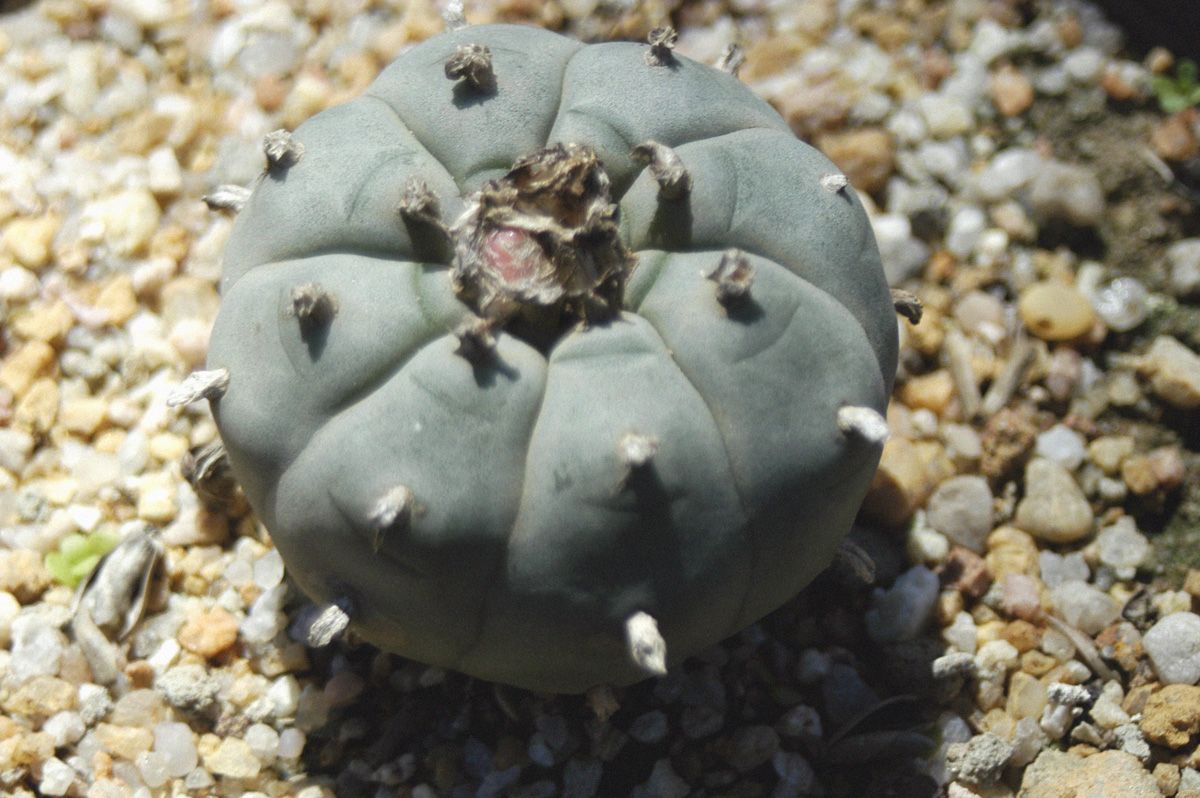
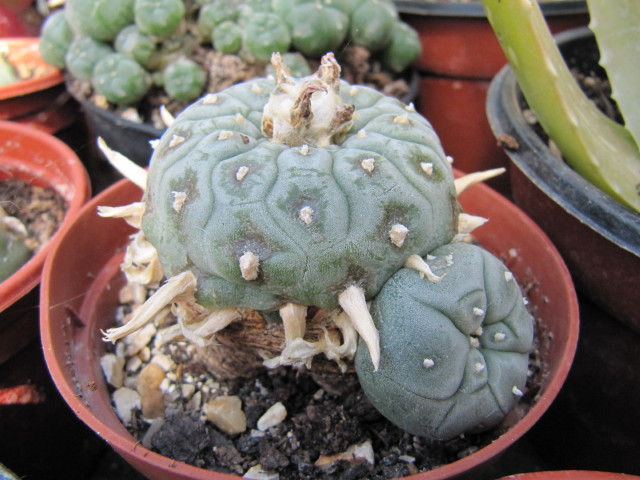
The crown is flat or gently domed with a depressed centre, blue-green to grey-green, usually with well-defined ribs — 5, 8 or 13, occasionally more with age — low, rounded and sometimes spiralling around the stem. Areoles carry tufts of wool rather than spines. Plants can branch into clusters with age.
Flowers
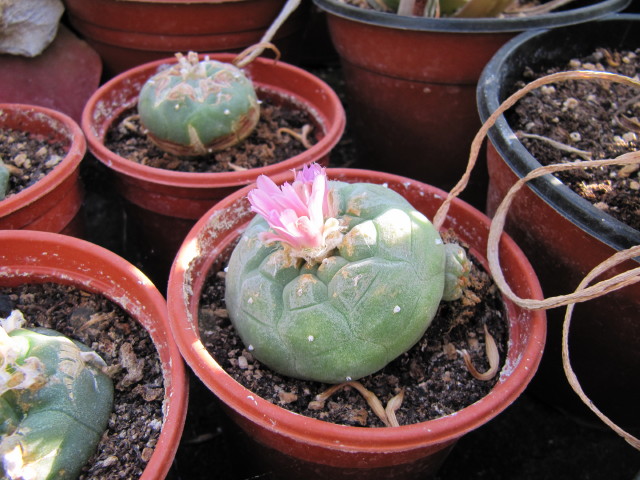
Diurnal, opening at the crown, pink with paler margins and a darker midstripe, roughly 1–3 cm across.
Root
A substantial, fleshy, carrot-shaped taproot sits below the visible crown.
Distribution and habitat
Native to southwestern and southern Texas and northeastern Mexico, reaching south to Jalisco. It grows in desert scrub, particularly thorn scrub, commonly on or near limestone, most often at elevations of roughly 100 to 1,500 m (occasionally to 1,900 m). In parts of its range, most individuals grow beneath the canopy of a nurse shrub such as honey mesquite rather than in the open.
Kew · Lophophora williamsii ↗ · Wikipedia · Peyote — habitat ↗
Similar species
Within the genus, L. diffusa is yellow-green with poorly defined ribs and paler flowers, and L. fricii tends toward a paler, more bluish grey-green with less-defined ribs and larger, often darker pink flowers — see the genus comparison table. Outside the genus, Ariocarpus fissuratus has flattened, overlapping, fissured tubercles rather than the more regular ribs of Lophophora, and Astrophytum asterias keeps a constant eight ribs for life, shows small whitish scales, has a fibrous root system rather than a taproot, and flowers yellow rather than pink. The two grow in overlapping habitat and are sometimes confused in the field.
Cactus Conservation Institute · Astrophytum and Lophophora — so similar, yet so different ↗
Cultivation
General cultivation requirements for L. williamsii. See the soil-mix guide and the seasonal-care calendar for the reasoning behind each line below.
| Light | Bright light, with direct sun limited to part of the day, especially for young or recently repotted plants |
|---|---|
| Soil | Gravelly, well-drained, mineral-heavy mix on the alkaline side — see the soil-mix guide for a tested recipe |
| Watering | Water and let the mix dry fully through the growing season; keep dry and frost-free over winter — see the seasonal-care calendar |
| Temperature | Reported comfortable range is roughly 18–30°C (64–86°F); protect from cold, wet exposure |
| Propagation | From seed, commonly cited at 10 to 30 years to flowering size — see the seed-growing guide; or grafted onto faster-growing stock — see the grafting guide |
Cultivars and forms
Two horticultural names remain in use among growers for particular forms of L. williamsii, although neither is a separate accepted taxon. L. williamsii var. decipiens, a Croizat name from 1944, is often found on older, garden-labelled plants; a later study found that most plants historically carrying this label are now thought to be L. fricii, a species not described until 1975. L. jourdaniana, described by Habermann in 1975, is used in cultivation for a violet to dark pink-red-flowered form; no wild population bearing this name has been confirmed. Both are Kew-recognized synonyms of L. williamsii — see their own pages for how each name is used today.
A wild population is also recognized as a distinctive growth form rather than a named cultivar: at Miquihuana, in the Mexican state of Tamaulipas, virtually all plants are caespitose (clump-forming) and begin sprouting lateral branches as seedlings, whereas other Lophophora populations generally branch only after reaching maturity, if at all.
Terry, M., "Stalking the Wild Lophophora, Part 2: Zacatecas, San Luis Potosi, Nuevo Leon, and Tamaulipas," Cactus and Succulent Journal 80(5), 2008.
Taxonomy and names
Kew accepts Lophophora williamsii (Lem. ex J.F.Cels) J.M.Coult., with 35 recorded synonyms, including the two horticultural names covered under Cultivars and forms above. The current author citation reflects a 2023 nomenclatural review that traced the basionym, Echinocactus williamsii, to an 1842 publication by Lemaire ex J.F. Cels, predating the "Salm-Dyck" attribution still seen in some older sources. Kew currently recognizes four species in the genus — the recently described dwarf species L. alberto-vojtechii, L. diffusa, L. fricii and L. williamsii; older two-, three- or five-species treatments used different, non-equivalent boundaries and should not be combined with the current one.
Conservation and legal status
IUCN lists L. williamsii as Vulnerable (VU) in a 2017 amended assessment. Field conservation work documents pressure on wild populations from over-collection and habitat loss; cultivated plants are not a substitute for conserving wild populations. In the United States, peyote — including L. williamsii — is a Schedule I controlled substance under the Controlled Substances Act. Federal regulation exempts the non-drug use of peyote in bona fide religious ceremonies of the Native American Church, and NAC members using peyote this way are exempt from registration; anyone who manufactures or distributes peyote for the Church must still register annually. That exemption is narrow and specific — it is not a general cultivation or possession allowance, and it does not extend to other uses. Status varies by country and by U.S. state, and can change; check current federal, state and local law, plus the sourcing guide, before acquiring, moving or propagating any plant material. The wider Cactaceae family, which includes this species, is also covered by a CITES Appendix II listing that regulates international trade in wild-sourced specimens.
IUCN Red List · Lophophora williamsii ↗ · Cornell Law · 21 CFR § 1307.31, Native American Church ↗ · Cactus Conservation Institute · Lophophora research ↗
References
- Kew POWO · Lophophora williamsii ↗
- Flora of North America · Lophophora williamsii ↗
- IUCN Red List · Lophophora williamsii ↗
- Cornell Law · 21 CFR § 1307.31 ↗
- Wikipedia · Peyote ↗
- Cactus Conservation Institute · Astrophytum and Lophophora ↗
- NC State Extension · Lophophora williamsii ↗
- Terry, M., "Stalking the Wild Lophophora, Part 2: Zacatecas, San Luis Potosi, Nuevo Leon, and Tamaulipas," Cactus and Succulent Journal 80(5), 2008.