Quick facts
| Family | Cactaceae |
|---|---|
| Subfamily | Cactoideae |
| Tribe | Trichocereinae (subtribe of Cereeae), per the 2025 phylogenomic classification used elsewhere on this site; historically placed in the broader tribe Trichocereeae (Hunt et al., The New Cactus Lexicon, 2006). |
| Genus | Leucostele Backeb. emend. Schlumpb. — segregated from Echinopsis sensu lato in 2012. |
| Accepted name (Kew) | Leucostele terscheckii (J.Parm. ex Pfeiff.) Schlumpb., Cactaceae Syst. Init. 28: 29 (2012) |
| Synonyms | Trichocereus terscheckii (J.Parm. ex Pfeiff.) Britton & Rose (1920), homotypic; Echinopsis terscheckii (J.Parm. ex Pfeiff.) H.Friedrich & G.D.Rowley (1974), homotypic; Cereus terscheckii J.Parm. ex Pfeiff., Allg. Gartenzeitung 5: 370 (1837), the basionym |
| Common names | None widely established in the sources reviewed for this page. |
| Native range | Bolivia and northwestern Argentina (POWO) |
| Conservation status | IUCN Vulnerable (VU), population decreasing — 2017 assessment, filed under the name Echinopsis terscheckii. CITES Appendix II, as for the whole family Cactaceae. |
Description
Britton and Rose (1920) described plants becoming extensively branched with age, reaching 10–12 m, with eight to fourteen ribs, yellow spines and large white flowers.
Stem and ribs
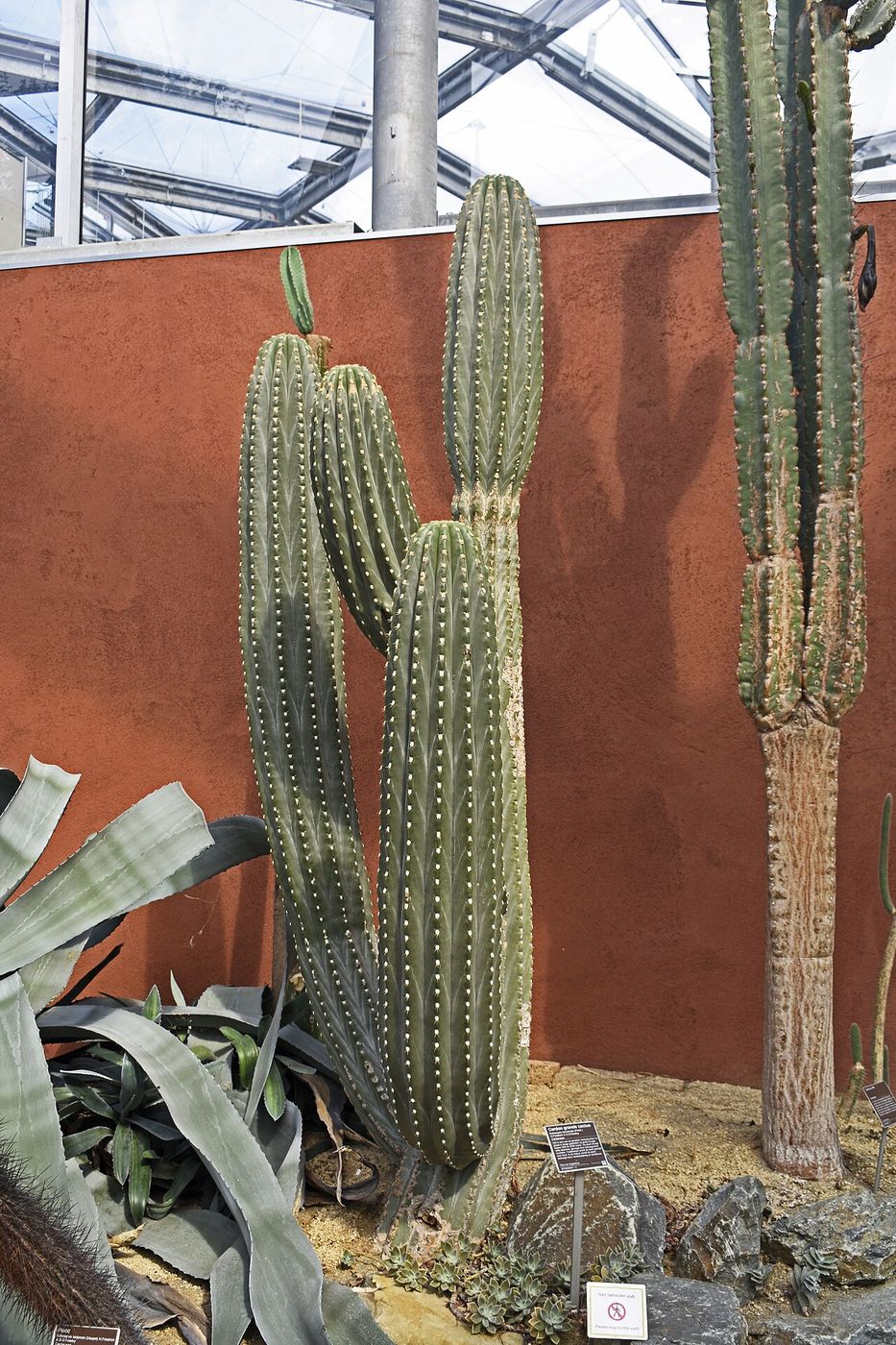
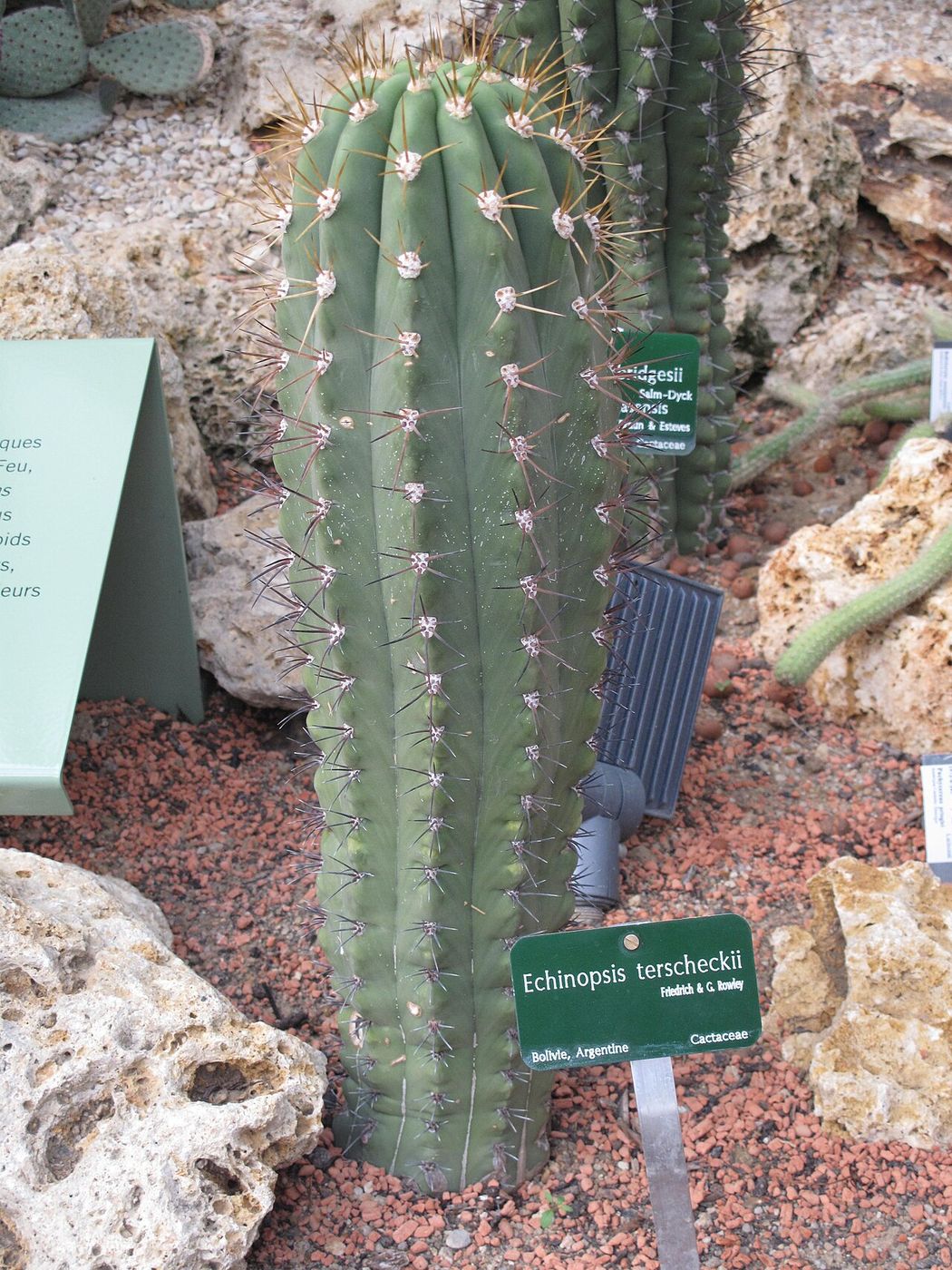
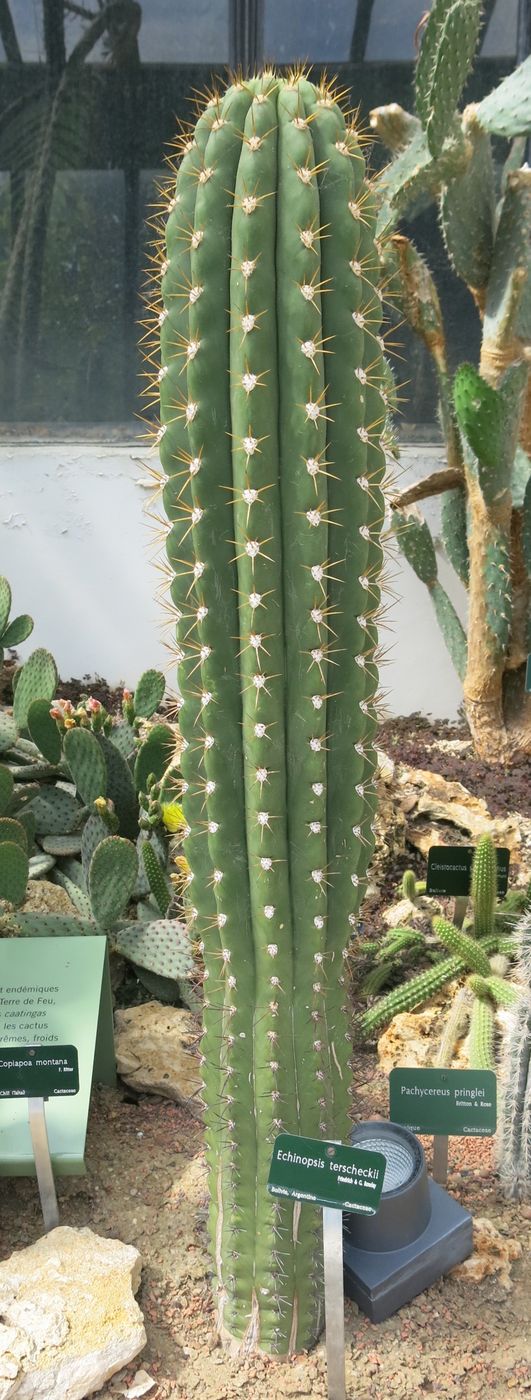
Columnar and branching, becoming markedly tree-like with age. Stems are light green and cylindrical, reported 10–20 cm in diameter, with eight to fourteen ribs, sometimes reported up to eighteen. Wild individuals are reported reaching roughly 7.6–12 m tall with trunk diameters up to 45 cm.
Areoles and spines
Areoles are spaced roughly 2.5 cm apart and carry eight to fifteen yellowish-to-brownish spines, several reported 8–10 cm long — among the longest-spined plants in this group.
Flowers
White, funnel-shaped and night-opening, reported 15–20 cm long and 13–15 cm across.
Britton & Rose · The Cactaceae, volume 2 (1920), pp. 134–140 ↗ · Wikipedia · Leucostele terscheckii ↗
Distribution and habitat
Native to Bolivia and northwestern Argentina (POWO), across arid and semi-arid Andean terrain within that range.
Similar species
Sheer scale is the most reliable field cue: mature terscheckii develops a thick, tree-like trunk and far more numerous, longer spines than pachanoi, bridgesii or peruvianus. A young seedling, though, can resemble other columnar Trichocereus/Echinopsis and cannot be identified on rib count alone.
Cultivation
Established plants eventually become tree-sized, with a thick trunk and long spines — plan placement, handling and eventual space around the mature habit, not the seedling. The ranges below are reported starting points from cultivation sources, not a fixed schedule; adjust for your own climate, pot size and season.
| Factor | What sources report |
|---|---|
| Light | Full sun for mature plants; introduce young or newly potted specimens to direct light gradually. |
| Soil | A gritty, mineral-heavy, fast-draining mix is generally recommended. See the soil mix guide. |
| Watering | Soak thoroughly in active growth, then let the mix dry completely before watering again; reduce frequency further in cool or dim periods, given this species’ reported slow early growth. See the seasonal care guide. |
| Temperature | Sources vary: one reference describes brief frosts tolerated to about −8 °C when bone-dry, while a nursery source recommends keeping container plants frost-free above about 10 °C. Treat cold tolerance cautiously and prioritize dry roots. |
| Propagation | Species-specific propagation notes were not found among the sources reviewed for this page; general columnar-cactus cutting method is covered in the propagation guide. |
| Growth | Reported as slow while young, becoming more vigorous with size, heat and sun — notably slower early on than several other commonly grown Trichocereus/Echinopsis. |
| Use as grafting stock | Not commonly documented as understock in the grafting sources reviewed here, consistent with its slow early growth; pachanoi and peruvianus are the stocks more typically described. See the grafting guide. |
Useful Temperate Plants · Leucostele terscheckii ↗ · Foliage Factory · Leucostele terscheckii ↗ · Cactocereus · Grafting cactus 101 ↗
Taxonomy and names
Kew's current accepted name is Leucostele terscheckii (J.Parm. ex Pfeiff.) Schlumpb. (2012). Trichocereus terscheckii Britton & Rose (1920) and Echinopsis terscheckii H.Friedrich & G.D.Rowley (1974) are both homotypic synonyms — the same nomenclatural type under different generic placements, not three different plants.
The genus Leucostele was validated and emended by Schlumpberger in 2012 on the strength of Schlumpberger & Renner's molecular phylogeny, which found Echinopsis sensu lato (as then circumscribed, including Trichocereus) to be polyphyletic (not a single natural group). Leucostele covers the Chilean, northwestern-Argentine and Bolivian "white-spined" Trichocereus-type columnars, including terscheckii, atacamensis, chiloensis and several others.
The IUCN Red List has not caught up with this reclassification: its live record for this species is still filed under the name Echinopsis terscheckii, not Leucostele terscheckii.
Growers continue to search for and sell this plant mostly as "Trichocereus terscheckii," which is why that name is kept as this page's heading. See Trichocereus / Echinopsis for the wider genus-level naming picture.
Conservation and legal status
IUCN Red List: Vulnerable (VU, criteria A2cd), population decreasing. Assessed by Ortega-Baes, P. & Lowry, M. (2017, an amended version of a 2013 assessment, originally assessed in 2010); IUCN Red List 2017: e.T152300A121467806. The assessment record is filed under the name Echinopsis terscheckii.
CITES: the whole family Cactaceae, including this species, is listed on CITES Appendix II; terscheckii is not among the small set of cactus taxa singled out for the stricter Appendix I.
References
Britton & Rose · The Cactaceae, volume 2 (1920) ↗ · Kew POWO · Leucostele terscheckii ↗ · Wikipedia · Leucostele terscheckii ↗ · Useful Temperate Plants · Leucostele terscheckii ↗ · Foliage Factory · Leucostele terscheckii ↗ · Cactocereus · Grafting cactus 101 ↗ · IUCN Red List · Echinopsis terscheckii (2017) ↗